Garnem Rootstock: Nematode & Iron-Chlorosis Tolerance
Discover how Garnem rootstock combines root-knot nematode resistance with 12% active lime tolerance to secure high stone fruit yields in calcareous soils.
Introduction to Garnem: The Red-Leaf Almond-Peach Hybrid
In Mediterranean stone fruit production, soil constraints such as high calcium carbonate levels, elevated pH, and endemic soil-borne pathogens frequently limit plantation longevity and yield stability. Developed to overcome these severe edaphic limitations, Garnem® is an elite interspecific hybrid resulting from a targeted cross between the Spanish almond Prunus dulcis 'Garfi' and the red-leaf peach Prunus persica 'Nemared'. As a pioneering plant biotechnology laboratory established in 1986 in Barcelona, Spain, we at IN VITRO SL have integrated this superior selection into our certified production protocols to supply agricultural producers with ultra-clean, high-performance starting material.
Key Agronomic and Morphological Characteristics
- Interspecific Hybrid Pedigree: Combines the carbonate tolerance and expansive root structure of almond with the complete root-knot nematode resistance inherited from peach.
- Distinctive Red Foliage: Intense anthocyanin pigmentation produces red leaves that facilitate nursery identification and allow field workers to instantly spot and remove unwanted rootstock suckers.
- Broad Graft Compatibility: Demonstrates excellent affinity with commercial peach, nectarine, and almond cultivars, as well as select plum varieties.
- Superior Field Vigour: Imparts strong initial tree vigour comparable to GF 677, driving rapid canopy development and early commercial bearing.
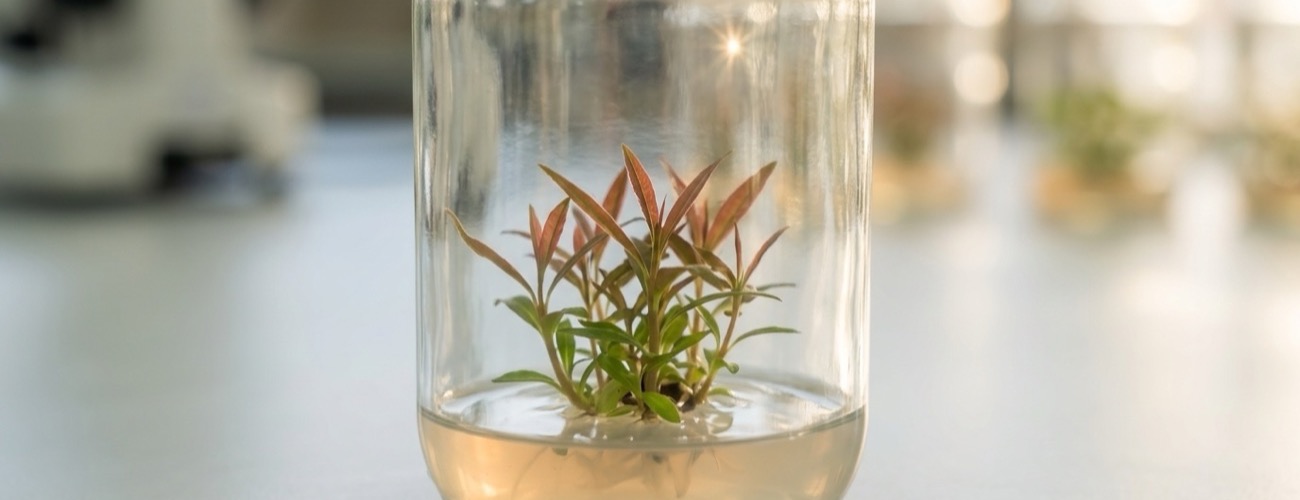
Leveraging nearly four decades of expertise in fruit tree micropropagation, we reproduce Garnem® through large-scale in vitro multiplication under rigorous sanitary standards. This technical precision ensures complete freedom from harmful viruses and viroids while providing uniform, highly acclimatized plants capable of thriving across challenging agricultural soils.
Genetics and Parentage: The Science Behind Garnem
At IN VITRO SL, our laboratory has dedicated nearly four decades to advancing commercial plant micropropagation and tissue culture. The development of the Garnem® rootstock represents a significant milestone in stone fruit biotechnology. Bred by the Centro de Investigación y Tecnología Agroalimentaria de Aragón (CITA) under the direction of Dr. Antonio J. Felipe, Garnem® is an interspecific hybrid derived from a targeted cross between the native Spanish almond cultivar 'Garfi' (Prunus dulcis) and the red-leafed North American peach cultivar 'Nemared' (Prunus persica). This strategic parentage combines the agronomic hardiness of Mediterranean almond genetics with the specialized nematode resistance mechanisms of elite peach lines.
- 'Garfi' Maternal Line: Confers exceptional root vigour, physiological tolerance to high active lime and alkaline soils (pH 8.0 to 8.5), and strong drought resilience typical of Mediterranean landraces.
- 'Nemared' Pollen Line: Imparts dominant biological immunity to root-knot nematodes (Meloidogyne species) alongside distinctive anthocyanin leaf pigmentation (red leaves) that simplifies nursery identification.
- Hybrid Synergies: Delivers high graft compatibility across commercial peach, nectarine, and almond varieties while matching the vigour profile of established selections.
By uniting these disparate genetic traits into a singular genotype, Garnem® resolves the historic trade-off between abiotic stress adaptation and biotic root protection. For commercial growers establishing orchards in difficult soils, this interspecific hybrid provides a robust biological foundation. Since initiating large-scale micropropagation in the 1990s, we have ensured that every Garnem® plant produced in our Sant Feliu de Llobregat facilities preserves the exact genetic fidelity and health status required for long-term plantation success. When selecting fruit tree rootstocks, verified genetic uniformity is essential to prevent field segregation and ensure uniform orchard performance.
Mechanism of Root-Knot Nematode Resistance
Root-knot nematodes (Meloidogyne spp.) represent one of the primary phytopathological barriers in commercial stone fruit production, causing severe root galls, vascular impairment, and rapid yield decline in replant soils. Garnem® derives its resistance to root-knot nematodes from its paternal lineage, developed by crossing the Spanish almond cultivar Garfi (Prunus dulcis) with the resistant peach cultivar Nemared (Prunus persica). This hybrid genetic inheritance confers multi-species resistance against major root-knot nematodes.
At the cellular level, the defensive biological response in Garnem® root tissues effectively halts giant cell formation and prevents nematode feeding site establishment. This arrests the pest reproduction cycle naturally, protecting the root system without requiring chemical soil fumigants or synthetic nematicides.
- Genetic Origin: Direct inheritance of dominant resistance factors from Nemared peach parentage.
- Target Pathogens: General immunity against major root-knot nematode species (Meloidogyne spp.).
- Agronomic Benefit: Eliminates reliance on hazardous soil fumigation in nematode-infested replant orchards.
For commercial growers establishing orchards on replant land, field-propagated rootstocks carry high risks of latent soil-borne contamination and genetic variation. Drawing on nearly four decades of micropropagation expertise as a pioneering laboratory founded in 1986, we supply certified fruit tree rootstocks propagated under strict aseptic conditions. In vitro micropropagation ensures that every Garnem® plantlet is delivered completely virus-free, nematode-free, and genetically uniform, providing maximum root system architecture and plantation longevity.
Iron-Chlorosis Tolerance in High-pH Calcareous Soils
In alkaline soils typical of Mediterranean agricultural regions, high active lime concentrations and soil pH levels reaching up to 8.5 severely restrict iron availability. Bicarbonate ions in soil solution inhibit root iron transport, inducing interveinal chlorosis that impairs leaf photosynthetic capacity and reduces orchard yields. The red-leaf hybrid Garnem® addresses this physiological constraint, demonstrating strong tolerance in soils containing up to 12% active lime[1]. At IN VITRO SL, our specialized micropropagation protocols preserve these adaptive physiological traits across every unit produced.
Garnem® overcomes iron deficiency chlorosis through a Strategy I root uptake mechanism characterized by rhizospheric proton extrusion and active enzymatic reduction. Under iron-limiting conditions, the root system upregulates membrane-bound ferric chelate reductase (FC-R) activity, converting insoluble Fe³⁺ into biologically active Fe²⁺ ions[2]. This physiological adaptation prevents leaf chlorosis, preserves chlorophyll biosynthesis, and sustains optimal photosynthetic electron transport rates throughout the vegetative cycle.
- Active Lime Tolerance: Sustains physiological performance in soils containing up to 12% active limestone at pH 8.5[1].
- Enzymatic Adaptation: Maintains elevated root ferric chelate reductase (FC-R) activity in bicarbonate-rich substrates[2].
- Photosynthetic Efficiency: Prevents iron-deficiency chlorosis to ensure continuous carbon assimilation and foliage growth.
- Clonal Homogeneity: In vitro multiplication delivers uniform rootstock genetics, guaranteeing consistent stress tolerance across commercial plantings.
By uniting natural hybrid resilience with tissue culture precision, Garnem® provides commercial growers with long-term yield stability in high-pH calcareous soils while significantly reducing dependence on expensive iron chelate corrections.
Vigour, Anchorage, and Stone Fruit Crop Suitability
At IN VITRO SL, our pioneer experience in commercial plant micropropagation since 1986 confirms that Garnem® provides high vegetative vigour and crop productivity across intensive stone fruit operations. As an almond x peach hybrid (Prunus dulcis x Prunus persica), Garnem® establishes a deep, expansive root framework that ensures exceptional soil anchorage and efficient water transport, preventing tree lodging in light or stony soils. This structural stability supports high yield efficiency in commercial peach, nectarine, almond, and compatible plum orchards, matching the vigour profile of classic rootstocks such as GF 677 while imparting superior stress resistance[1].
- Orchard Vigour and Canopy Growth: Drives rapid canopy establishment, promoting early fruit bearing and high yield density across peach and almond cultivars.
- Robust Anchoring Architecture: Penetrates deeply into soil profiles, providing mechanical stability against wind loading and optimizing nutrient uptake in dryland conditions.
- Red Foliage Marker: High anthocyanin expression in leaves provides clear color contrast against scion foliage during nursery propagation and field maintenance.
- Wide Graft Affinity: Demonstrates complete anatomical compatibility with peaches, nectarines, almonds, and selected plum varieties.
From an operational perspective, the red foliage inherited from its red-leaved peach parent (Nemared) represents a valuable management asset. In nursery production and young orchard management, distinguishing rootstock suckers from scion growth is critical to prevent canopy takeover. The high anthocyanin pigmentation of Garnem® creates immediate visual differentiation against the green shoots of the grafted scion, enabling field crews to perform rapid, precise debudding and sucker removal. This operational trait eliminates costly identification errors, minimizes labor hours, and ensures that the genetic benefits of our micropropagated material are fully preserved throughout the orchard's lifespan.
Direct Comparison: Garnem versus GF677 Rootstock
When selecting stone fruit rootstocks for replant sites and challenging Mediterranean soils, growers frequently evaluate Garnem® against GF 677. Both selections deliver exceptional vegetative vigour and high agronomic adaptability in calcareous environments, supporting early orchard establishment and high yield productivity. However, critical physiological differences determine their long-term field performance under specific soil-borne biotic and abiotic stress factors.
In soil adaptability, both Garnem® and GF 677 demonstrate robust iron-chlorosis tolerance, enduring active lime concentrations up to 12% without exhibiting severe interveinal chlorosis[1]. The critical divergence between these two hybrids lies in pest resistance: while GF 677 remains highly vulnerable to root-knot nematodes, Garnem® inherits total resistance to Meloidogyne species (including Meloidogyne incognita, Meloidogyne javanica, and Meloidogyne arenaria) from its Prunus persica 'Nemared' parent[1]. Furthermore, the distinctive red foliage of Garnem® facilitates effortless visual identification during nursery budding operations.
| Agronomic Parameter | Garnem® Rootstock | GF 677 Rootstock |
|---|---|---|
| Parentage | Prunus dulcis 'Garfi' x P. persica 'Nemared' | Prunus dulcis x Prunus persica |
| Active Lime Tolerance | Up to 12% active lime[1] | Up to 12% active lime |
| Root-Knot Nematodes (Meloidogyne spp.) | Resistant / Immune | Susceptible |
| Plant Vigour | Very High | Very High |
| Foliage Color | Red-purplish (easy budding detection) | Green |
Since initiating our large-scale micropropagation of rootstocks in 1990, our pioneering tissue culture laboratory has provided commercial fruit growers with certified, genetically uniform, and phytosanitarily pristine planting material. Utilizing standardized in vitro multiplication protocols honed over 40 years of experience, we eliminate soil-borne pathogen transmission risks and ensure that every Garnem® plant retains its true-to-type genetic resistance, protecting commercial plantations against premature replant decline.
In Vitro Micropropagation: Ensuring Phytosanitary Purity
As a pioneering micropropagation laboratory established in 1986 in Sant Feliu de Llobregat, Barcelona, we at IN VITRO SL have refined tissue culture protocols over 40 years of experience. Our laboratory was the first in Spain to secure official Breeder and Selector certification, as published in the Official State Gazette (BOE 11.07.1990). When propagating fruit tree rootstocks, micropropagation guarantees absolute phytosanitary purity by regenerating healthy meristematic tissue in sterile culture media, completely eliminating systemic viruses, viroids, and latent bacterial pathogens.
Traditional macropropagation techniques such as hardwood cuttings or stool beds carry an inherent risk of transferring soil-borne fungal pathogens-such as Verticillium dahliae-and root-knot nematodes directly into clean commercial orchards. Furthermore, adventitious rooting under field conditions often produces asymmetrical root systems or root malformations, compromising anchorage and nutrient translocation. In contrast, in vitro multiplication yields true-to-type Garnem® plants with balanced, radial root morphology and zero pathogen load, ensuring maximal plantation longevity and uniform field performance[1].
- Aseptic Meristem Culture: Isolation of disease-free apical meristems under sterile laminar flow conditions.
- Controlled In Vitro Multiplication: Rapid cellular division without exposure to soil vector organisms or viral carriers.
- Rigorous Phytosanitary Indexing: Molecular and serological screening ensuring strict compliance with Official Selector certification standards.
- Optimized Root System Architecture: Uniform adventitious rooting that prevents structural malformations and root twisting.
By supplying certified virus-free starting material through rigorous tissue culture protocols, we provide commercial growers with genetically stable, high-vigour Garnem® stock capable of establishing robust, productive stone-fruit orchards even under challenging soil and phytosanitary conditions.
Frequently asked questions
What species are crossed to produce Garnem rootstock?
Garnem is an interspecific hybrid developed by CITA Aragon in Spain, created by crossing the Spanish almond cultivar Garfi (Prunus dulcis) with the North American peach cultivar Nemared (Prunus persica).
How does Garnem compare to GF677 regarding nematode resistance?
While GF677 is susceptible to root-knot nematodes, Garnem delivers resistance to Meloidogyne species, making Garnem the superior selection for infested or replant orchard soils
What active lime level can Garnem rootstock tolerate?
Garnem tolerates up to 12% active lime in soils with a pH reaching 8.5 without developing severe iron-deficiency chlorosis, matching the lime tolerance of GF677.
Why does Garnem rootstock have red leaves?
Garnem inherited anthocyanin leaf pigmentation from its Nemared parent. The distinct red leaves provide visual differentiation, making debudding and rootstock sucker removal simple
What fruit species are compatible with Garnem rootstock?
Garnem displays excellent graft compatibility with peach, nectarine, almond, and select plum and apricot varieties, inducing high tree vigour and early cropping.
Why choose in vitro micropropagated Garnem rootstocks over traditional cuttings?
In vitro tissue culture guarantees certified virus-free material, superior root branching without J-root defects, clonal uniformity, and maximum initial field establishment rate