Self-Rooted vs Grafted Fruit Trees: Commercial Orchards
Compare self-rooted and grafted fruit trees for commercial orchards. Evaluate uniformity, disease, suckering, and long-term production costs.
Self-Rooted vs Grafted Fruit Trees: Core Botanical Differences
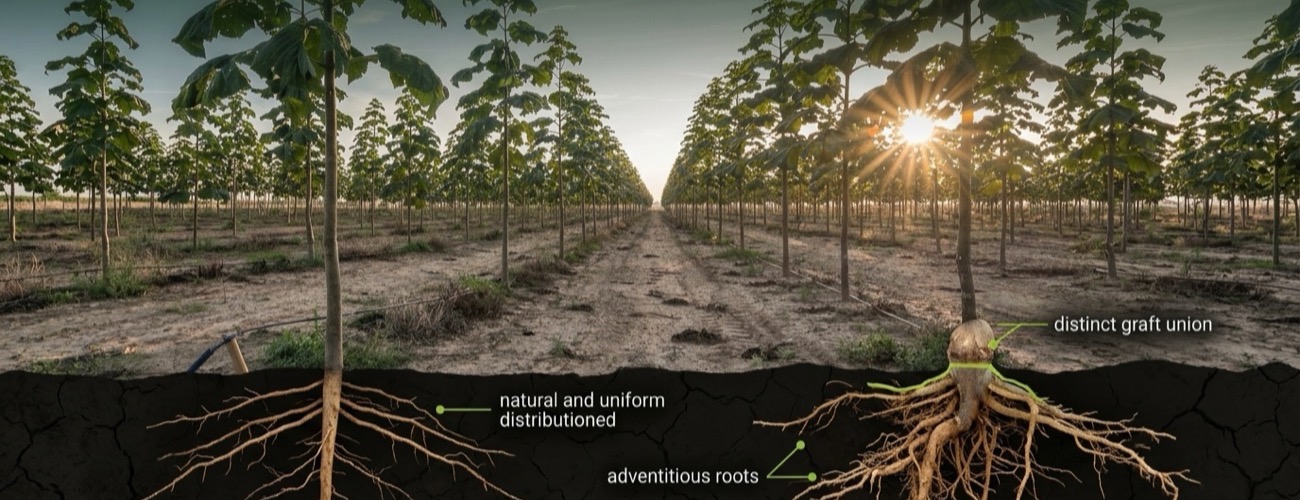
At IN VITRO SL, our 40+ years of experience in plant tissue culture demonstrate that the structural divergence between self-rooted and grafted fruit trees originates at the cellular level. A grafted tree is a composite organism formed by joining two genetically distinct individuals at a graft union. In contrast, self-rooted trees produced through micropropagation develop as a single, uniform organism from root system to canopy terminal. This fundamental distinction directly governs vascular continuity, tissue differentiation, and long-term orchard stability.
Vascular Integrity and Tissue Culture Regeneration
In grafted trees, vascular connection depends on callus formation and secondary differentiation between scion and rootstock tissues. Incomplete vascular alignment or delayed graft incompatibility frequently creates systemic bottlenecks that restrict xylem and phloem transport. By applying specialized in vitro multiplication through our plant reproduction services, micropropagated plants bypass the graft junction entirely. Juvenile meristematic tissues regenerate continuous vascular bundles, ensuring uninterrupted sap flow and nutrient translocation.
- Vascular Continuity: Self-rooted trees establish continuous vascular tissues, avoiding the translocation resistance associated with graft union scars.
- Root and Crown Architecture: Tissue culture plants differentiate a symmetrical adventitious root system directly connected to the crown base.
- Genetic Stability: Single-organism propagation preserves uniform genetic stability throughout subterranean and aboveground tissues without scion-rootstock interactions.
This structural uniformity directly influences crown development. Free from the physiological imbalances caused by rootstock-scion interactions, self-rooted trees develop balanced canopy architecture and superior mechanical strength, delivering greater resilience for high-density orchard management.
Uniformity and Vigour Control in Modern Orchard Architecture
In traditional commercial orchards established with grafted trees, canopy development is inherently modulated by the subterranean interaction between two distinct genotypes. Variations in vascular graft union resistance, root hormone synthesis, and hydraulic conductivity frequently introduce erratic vigour across the orchard block. In vitro micropropagation eliminates these graft-induced micro-variations by regenerating complete trees from elite somatic tissue, yielding 100 percent genetic uniformity above and below ground.
Canopy Architecture and Harvesting Mechanics
For commercial fruit growers operating high-density orchard designs, canopy uniformity directly determines operational efficiency and yield quality. Uniform shoot growth establishes consistent foliage density, ensuring balanced light interception across the entire canopy profile. This structural predictability optimizes automated hedge-pruning, pneumatic thinning, and mechanical harvesting equipment, as trunks and scaffolds develop identical spatial dimensions.
| Architectural Parameter | Micropropagated Self-Rooted Trees | Grafted Rootstock Combinations |
|---|---|---|
| Genotype Identity | Single uniform genome across roots and shoots | Dual composite genome with graft union interface |
| Vigour Distribution | Symmetrical branch development and uniform canopy density | Variable canopy density driven by rootstock vigour gradients |
| Mechanized Operations | Optimized for automated pruning and mechanical harvesting | Requires ongoing adjustments for uneven trunk and limb sizes |
| Dwarfing Mechanism | Natural physiological balance based on scion genetics | Hormonal and hydraulic restriction at graft union |
At IN VITRO SL, leveraging over 40 years of plant tissue culture expertise from our laboratory in Barcelona, we produce both Self-Rooted Varieties and micropropagated Fruit Tree Rootstocks (GF 677, Garnem®). While dwarfing rootstocks remain essential when extreme vigour suppression is required in dwarf trellis systems, self-rooted micropropagated trees deliver unmatched canopy stability and long-term structural integrity for modern commercial production.
Graft Incompatibility, Root Suckering, and Replant Disease Risk
In commercial fruit production, grafting two distinct genotypes (a scion variety and a rootstock) introduces inherent physiological and structural vulnerabilities. Over 40 years of tissue culture research at our Sant Feliu de Llobregat laboratory demonstrates that mechanical graft unions often fail to achieve complete vascular continuity. In contrast, micropropagated trees establish a single, unified vascular system that eliminates structural failure risks and optimizes metabolic transport.
Anatomical Stability, Suckering Elimination, and Replant Mitigation
Delayed graft incompatibility remains a persistent hazard in traditional orchards, where trees appear healthy initially but suffer catastrophic breakage under heavy crop loads or environmental stress years after planting. Furthermore, hormonal discrepancies across the graft interface trigger persistent root suckering, producing unwanted adventitious shoots that divert nutrients from the canopy and require costly manual pruning. By propagating elite selections through our plant reproduction services, our non-GMO Self-Rooted Varieties eliminate the graft union entirely, preventing suckering and mitigating replant disease risks through uniform, vigorous root systems.
| Physiological Feature | Grafted Orchard Combinations | Micropropagated Self-Rooted Varieties |
|---|---|---|
| Vascular Connection | Disrupted at graft union; vulnerable to delayed failure | Seamless cellular vascular continuity from roots to shoot |
| Root Suckering | Frequent shoots from hormonal imbalance; increases labor | Completely eliminated; roots and canopy share identical genetics |
| Replant Vigor | Heterogeneous root establishment; prone to replant stress | High uniform root development and enhanced soil adaptation |
Eliminating graft union vulnerabilities simplifies orchard management while safeguarding capital investment. When commercial growers deploy self-rooted starting material developed through in vitro micropropagation, they achieve consistent tree vigor, lower maintenance costs, and superior long-term field stability.
Nursery Establishment Costs and Long-Term Field Performance
When evaluating orchard establishment, commercial growers must balance upfront nursery plant costs against multi-decade operational efficiency and field maintenance expenses. Traditional grafted tree production requires dual-stage cultivation-growing a rootstock, maintaining scion mother plants, and performing manual budding or grafting-which increases initial nursery labor complexity. In contrast, our micropropagation laboratory produces Self-Rooted Varieties and uniform rootstocks directly in vitro. While tissue culture requires specialized aseptic facilities, large-scale production delivers genetically stable, phytosanitarily certified plant material with well-developed adventitious root systems. Longitudinal field studies on Prunus species confirm that micropropagated trees achieve comparable trunk cross-sectional area, flowering periods, and cumulative yield efficiency to grafted trees without performance decline over multi-year commercial lifespans.
- Initial nursery investment: Grafted stock requires double propagation handling and manual budding, whereas self-rooted micropropagated plants streamline production into a single, automated tissue culture cycle.
- Suckering and pruning labor: Grafted trees frequently produce unwanted rootstock suckers below the graft union, requiring repetitive manual removal every season. Self-rooted trees maintain genetic identity across all vegetative tissues, significantly reducing suckering.
- Orchard lifespan and structural integrity: Graft unions represent physical weak points vulnerable to frost cracking, mechanical damage, and vascular restrictions. Self-rooted trees eliminate graft incompatibility, supporting sustained vascular flow and crown health over multi-decade orchard lifespans.
- Operational cost reduction: Minimizing rootstock sucker removal and graft-line management lowers ongoing per-hectare maintenance labor across the entire plantation life cycle.
Since founding our laboratory in 1986 in Barcelona, Spain, our 40 years of experience in plant tissue culture have established that total cost of ownership favors plants engineered for uniform vigor and high health status. For commercial growers, self-rooted varieties minimize graft-line mortality and reduce annual orchard maintenance overhead, ensuring reliable yields and predictable economic returns.
Specific Agronomic Scenarios Where Self-Rooted Trees Excel
While grafted rootstock combinations remain standard in high-density stone fruit production, self-rooted trees derived from micropropagation offer distinct physiological advantages in specific commercial environments. Based on our 40 years of experience at IN VITRO SL since 1986, proprietary protocols enable the production of both elite Paulownia genetics and fruit tree rootstocks, as well as non-GMO Self-Rooted Varieties. Comparative field evaluations confirm that micropropagated own-root trees rapidly establish balanced root architecture and high vegetative vigor during early orchard development.
- Severe Frost and Freeze Recovery: In regions subject to extreme sub-zero winter events, lethal freeze damage can kill a grafted scion down to the graft union, resulting in total loss of the commercial cultivar. In contrast, Self-Rooted Varieties retain identical cellular genetics throughout both the root system and canopy, allowing adventitious shoots to regenerate true-to-type cultivars directly from the base following freeze injury.
- Saline and Marginal Soil Adaptation: Scion-rootstock graft unions can introduce vascular resistance that exacerbates ion toxicity and osmotic stress. Own-root trees eliminate graft union bottlenecks, facilitating unhindered nutrient translocation and superior root system adaptation in saline soils.
- High-Density Planting Schemes: In intensive planting configurations demanding absolute genetic stability and uniform canopy development, in vitro multiplication prevents rootstock-induced growth variations across orchard rows.
Through our specialized plant reproduction services, our laboratory ensures that every production batch meets strict phytosanitary hygiene and genetic uniformity standards. By opting for own-root micropropagated trees in target environments, commercial growers secure an orchard architecture designed for severe weather recovery and predictable long-term productivity.
Selecting the Optimal Tree System for Your Orchard Management
Selecting between micropropagated rootstocks and self-rooted cultivars requires a rigorous assessment of site-specific pedological factors, biological stress vectors, and capital horizons. With over 40 years of micropropagation experience since our founding in 1986, our laboratory recommends a systematic decision framework before establishing commercial orchards. Soil pathogen pressure, specifically the risk of replant disease complex caused by fungal and nematode vectors, often dictates root system selection. While specific grafted combinations using Fruit Tree Rootstocks (GF 677, Garnem®) offer proven tolerance against extreme soil pH, nematodes, or waterlogging, in vitro micropropagated Self-Rooted Varieties excel in virgin soils or low-pathogen environments where absolute genetic stability and elimination of graft union failure are prioritized.
- Soil Pathogen and Replant Screen: Conduct comprehensive DNA bioassays for Pratylenchus nematodes and soil-borne fungi. High pathogen counts necessitate specific resistant rootstock hybrids such as Garnem® or GF 677; clean soils permit the deployment of high-density Self-Rooted Varieties.
- Vigour and Architecture Allocation: Evaluate target tree spacing and mechanization requirements. Grafted rootstocks allow targeted dwarfing or vigour control, whereas self-rooted plants express natural, uniform vigour across the canopy.
- Suckering and Maintenance Audit: Assess labor expenditure associated with root suckering. Micropropagated self-rooted trees completely eliminate graft incompatibility and rootstock suckering, substantially reducing annual management costs.
- Long-Term Capital Allocation: Analyze total cost of ownership over a 15 to 20 year production cycle. While initial planting stock costs differ, self-rooted orchards frequently deliver superior long-term yield consistency and lower renewal overhead.
By balancing phytosanitary profiling with long-term financial modeling, commercial growers can optimize orchard architecture. We invite growers and technical directors to consult our laboratory team to evaluate site parameters and select certified, disease-free planting stock engineered for maximum productivity.
IN VITRO SL Micropropagation Protocols and Quality Control
Since our establishment in 1986 in Sant Feliu de Llobregat, Barcelona, we have led the sector as a pioneering micropropagation laboratory specializing in advanced plant biotechnology. Backed by more than 40 years of experience, IN VITRO SL became the first laboratory in Spain to secure official Selector certification in 1990, published in the Official State Gazette (B.O.E.). Our scientific team designs proprietary in vitro multiplication protocols that power the mass production of both elite Paulownia Clon InVitro 112® genetics and high-performance fruit crops. Commercial micropropagation under aseptic conditions provides an unmatched mechanism for virus eradication, eliminating systemic pathogens, viroids, and latent bacterial infections before plants enter commercial production.
- Aseptic Meristem Culture: Initiating cultures from apical meristems under sterile laboratory conditions eliminates systemic vascular viruses, fungal spores, and bacterial pathogens.
- Guaranteed Genetic Stability: Vegetative multiplication from single-genotype elite mother plants preserves complete true-to-type field performance and uniform growth architecture.
- Rigorous Phytosanitary Indexing: Every production batch undergoes certified testing under official ES/09/08-0016 standards to guarantee virus-free, non-GMO plant material.
- Controlled Ex Vitro Acclimatization: Multistage greenhouse hardening optimizes root development and stomatal control, ensuring maximal field establishment success.
We utilize these precise laboratory protocols across our entire production portfolio, including certified Fruit Tree Rootstocks (GF 677, Garnem®) and micropropagated Self-Rooted Varieties via our dedicated micropropagation services. Traditional field grafting introduces inherent vulnerabilities through graft union failures, vascular incompatibility, and potential viral transmission during manual top-working. By generating self-rooted trees directly in tissue culture, we eliminate graft union weaknesses entirely while maintaining robust, uniform root architecture across the orchard.
Commercial growers and agricultural investors require predictable capital returns that depend directly on plant health and orchard longevity. By securing certified starting material produced under our Selector protocols, growers mitigate replant disease risks, reduce early plantation mortality, and establish commercial orchards built on verified scientific rigor.
Frequently asked questions
What is the main difference between self-rooted and grafted fruit trees?
Self-rooted trees grow entirely on their own genetically identical root system created via in vitro micropropagation. Grafted trees combine a rootstock chosen for root traits with a scion chosen for fruit quality.
Do self-rooted fruit trees suffer from graft incompatibility?
No. Because self-rooted trees are grown from a single genotype without a graft union, they are completely immune to anatomical and physiological graft incompatibility.
How does micropropagation improve tree health in commercial orchards?
In vitro tissue culture micropropagation takes place under sterile laboratory conditions, producing certified virus-free and pathogen-tested plant material with maximum juvenile vigour.
Do self-rooted fruit trees produce root suckers?
Root suckering in self-rooted trees produces identical genetic shoots rather than wild rootstock sprouts, eliminating the risk of invasive rootstock takeover.
Which option is better for cold-climate orchards prone to freeze damage?
Self-rooted trees offer superior recovery after catastrophic freezes because regrowing root sprouts produce true-to-type fruit varieties rather than wild rootstocks.