Protecting Your Plant Variety When You Outsource Tissue Culture
How to protect your plant variety when outsourcing tissue culture: NDAs, material transfer agreements, stock ownership and plant breeders rights.
Why outsourced micropropagation exposes your variety
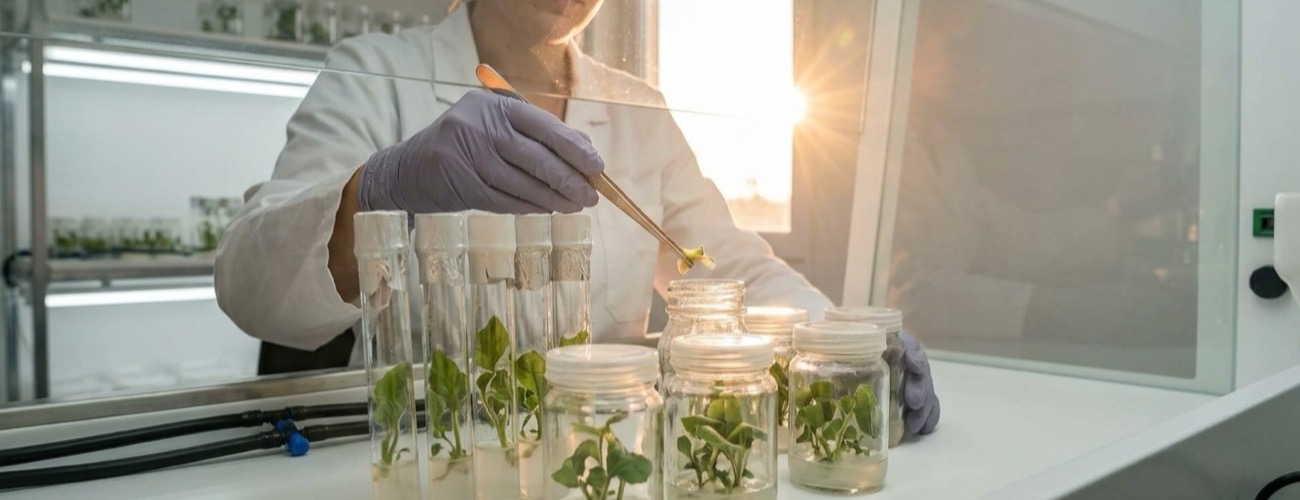
When a nursery sends a proprietary variety to a tissue culture laboratory, it temporarily surrenders physical control of its most valuable asset. Once explants enter the sterile workflow, every sub-culturing cycle creates living plant lines that the laboratory handles daily, on its own premises, under its own protocols. Your variety continues to exist, divide and multiply whether or not you are watching. This is the inherent nature of plant micropropagation: multiplication from a single tissue sample under controlled conditions, which is precisely what makes it efficient and precisely what makes it sensitive from an intellectual property standpoint.
Before drafting any contract, be clear about what actually leaves your control the moment the shipment is accepted:
- Mother stock: the master cultures from which every future plantlet will be derived, held and maintained by the laboratory.
- Media protocols: the exact recipes, sub-culturing intervals and environmental parameters that determine multiplication rates.
- Genotype identity: the documentation linking each culture line to your variety, which the laboratory must keep unambiguous across thousands of jars.
- Production records: the volumes produced, the batches dispatched and the destinations, which you do not administer directly.
The exposure is not theoretical. UPOV, the International Union for the Protection of New Varieties of Plants, notes that developing a successful variety takes 10 to 15 years for many species, and that once a variety is released it can often be easily reproduced by others, depriving the original breeder of the fair opportunity to benefit from the investment[1].
Outsourced micropropagation multiplies this exposure compared with conventional propagation. A cutting gives one new plant; a single explant in a tissue culture environment yields an effectively unlimited chain of sub-cultures, so one uncontrolled culture line can produce commercial volumes of your variety within a single season. Compared with traditional propagation methods, the economics are superior, but the consequence of a leak is correspondingly larger. The instruments described in the following sections exist to close that gap.
Plant breeders rights: the legal baseline for protection
The first layer of protection is statutory. The 1991 Act of the UPOV Convention establishes the breeder's right, and within the European Union it is implemented through the Community Plant Variety Right (CPVR), administered by the Community Plant Variety Office (CPVO) since 1995[2]. Under this framework, the authorization of the breeder is required to propagate the variety for commercial purposes, and specifically for the production or reproduction (multiplication) of the variety and for selling or other marketing of propagating material[3].
For a nursery operating across borders, the structural advantage is unitary effect: a single application to the CPVO yields a right valid throughout the European Union, where previously a breeder had to file separately in each Member State. The duration is 25 years as a general rule, extended to 30 years for vines, potatoes and trees[2].
Protection is granted only where the variety satisfies a defined set of technical and legal conditions, and it is worth knowing them precisely, because they define what you must be able to demonstrate:
| Requirement | What it means for your variety |
|---|---|
| Novelty | The variety must not have been sold or otherwise disposed of before the application date; the CPVO checks novelty as part of processing the application[4]. |
| Distinctness | The variety must be clearly distinguishable from any other variety of common knowledge at the date of application. |
| Uniformity | The variety is uniform in the expression of its characteristics. |
| Stability | The variety remains unchanged after repeated propagation, a criterion directly relevant to multiplication cycles in a tissue culture environment. |
| Denomination | A variety denomination that clearly identifies the variety and differs from existing denominations of the same or related species. |
One further principle matters for any outsourcing decision: only the breeder of a new plant variety can obtain protection of that variety, and it is not permitted for anyone else to do so[3]. A laboratory that propagates your material acquires no entitlement to file for the right itself, but a laboratory that is careless with your genetics can still destroy the commercial value of the right. That is where the next section applies.
Where plant breeders rights fall short
Registration is the baseline, not the guarantee. On 19 December 2019, the Court of Justice of the European Union ruled in case C-176/18 (Club de Variedades Vegetales Protegidas v Martínez Sanchís, the Nadorcott mandarin case), and the ruling clarified the scope of Community Plant Variety Rights in ways every breeder should understand before outsourcing propagation[5].
The ruling confirmed the cascade-protection system under Article 13 of Regulation 2100/94, a hierarchical structure with materially different levels of enforcement:
- Primary protection covers variety constituents, meaning entire plants or parts of plants capable of producing entire plants. Acts such as production or reproduction (multiplication) and selling require the holder's authorization.
- Secondary protection covers harvested material, and applies only if two extra conditions are met: the harvested material was obtained through unauthorised use of variety constituents, and the holder had no reasonable opportunity to exercise the right in relation to those constituents. Both conditions are onerous to prove in practice.
The Court also exposed a timing risk. During the provisional period between publication of the CPVO application and grant of the title, the applicant may claim only reasonable compensation and cannot prohibit propagation acts; the Court held that no obligation of prior authorisation exists in that window, so acts of propagation and sale carried out then cannot be regarded as unauthorised use even after the title is granted[6]. For a nursery, the practical conclusion is direct: the timing of outsourcing relative to your application and grant dates changes your enforcement position materially.
Finally, the breeder's exemption remains: under the UPOV Convention, the authorization of the breeder is not required for using a protected variety as an initial source of variation for breeding other varieties[7]. This is a deliberate design feature of the system, not a defect, but it means a statutory right alone will never control what a laboratory does with the physical material in its culture room. Contractual instruments must carry that load.
NDAs and confidentiality before registration
For varieties not yet registered, confidentiality is the protection layer that matters most, because novelty is fragile. The CPVO checks novelty as part of processing the application, and a variety that has been commercially disposed of before filing cannot satisfy that check[4]. Every shipment of explants to a laboratory before the application date is therefore a moment of legal risk, and it must be governed in writing before the material moves.
A confidentiality agreement with a micropropagation laboratory should be drafted for the specific realities of tissue culture, not adapted from a generic template.
An honest limit must be stated. A confidentiality agreement binds only its signatory; it does not prevent independent propagation once material circulates outside the contract, and it confers no right against third parties who lawfully obtain the genetics elsewhere. Treat the NDA as a bridge to registration, the instrument that preserves novelty and discipline during the development and application phase, not as a substitute for the breeder's right once the variety is ready for the market.
Material transfer agreements: controlling the stock itself
Where an NDA governs information, a material transfer agreement (MTA) governs the plant material itself. It is the instrument that follows the physical stock into the laboratory and defines what the recipient may do with it, which is why it deserves as much attention as the price negotiation.
The structure is well established in plant breeding practice. A reference example is the shrink-wrap MTA used by Cornell University's Center for Technology Licensing, which illustrates the elements a plant MTA should carry[8].
For a nursery, the distinction that matters is between academic and commercial instruments. The Cornell shrink-wrap MTA is explicitly limited to non-commercial, academic or research purposes, with no charge for the material beyond shipping[8]. That is the correct tool for a university exchange, and the wrong tool for a commercial multiplication run. When you outsource propagation of a variety you intend to sell, you need a negotiated commercial multiplication contract that incorporates the same MTA logic, identified lots, defined purpose, redistribution bans, but scaled to production volumes, delivery schedules and quality specifications.
Stock ownership, traceability and genetic verification
The question to ask before signing any multiplication contract is simple: when the contract ends, who holds the mother lines and the residual cultures? If the answer is not written down, the default is the laboratory's culture room, and that default works against you.
Contract terms for residual stock should be explicit and verifiable.
Genetic testing protocols are the practical enforcement tool behind these clauses. UPOV is precise on the point: a DNA profile is not the basis for obtaining protection of a variety, although this information may be used as supporting information, for example in disputes[9]. In other words, a genetic fingerprint will not replace the DUS examination, but it is what allows you to prove whose genetics ended up in whose field. Contracting for periodic genetic verification of the laboratory's production is a proportionate safeguard for any high-value variety, and it complements the laboratory disciplines that keep clones true-to-type.
Traceability signals in a laboratory partner tell you whether these clauses will mean anything in practice. Look for an official nursery registration number and documented verification of genetic identity. We can point to our own record: IN VITRO SL operates under nursery registration ES/09/08-0016, has held official SELECTOR certification since 1990, and had the unique genetic profile of Paulownia Clon InVitro 112® verified by All Genètics in 2017. A partner that subjects its own proprietary clone to independent genetic verification is demonstrating the practice you should demand for yours. Our full framework for evaluating a laboratory is set out in How to Choose a Micropropagation Lab Partner.
Structuring the multiplication agreement
The four instruments above are not alternatives; they are layers that only work assembled into a single contract. Before material ships, a nursery should be able to confirm that each of them is written into that contract.
The choice of laboratory deserves weight. A laboratory that has operated its own large-scale facilities for decades, under certification and across continents, has already been tested by the exact risks this article describes. Our In Vitro Multiplication Services page documents that record: over 40 years of expertise in plant tissue culture and micropropagation, supply of high-quality micropropagated plants across Europe, and multiplication agreements in Africa, Asia and the Americas[10].
That is the natural next step for nurseries that need this framework in place rather than drafted from scratch. In Vitro Multiplication Services provides large-scale micropropagation and multiplication in accredited laboratory facilities for commercial growers, agricultural companies and forestry enterprises requiring high-volume, virus-free plant cloning, and we structure every multiplication relationship so that ownership of the genetics, the protocols and the residual stock is never in doubt. Bring us your variety and your protection documents, and we will return the plants, not the rights.
Frequently asked questions
Does a micropropagation lab own the plants it produces from my variety?
No, not if the contract is drafted correctly. Ownership of the delivered plants is a commercial term you negotiate, but the underlying genetics remain yours: under the UPOV system the breeder's authorization is required to propagate a protected variety for commercial purposes. The contract should also state who owns residual cultures and sub-cultured lines left in the laboratory when production ends.
Do I need plant breeders rights before outsourcing tissue culture?
Registration is not a legal precondition for outsourcing, but it changes your position fundamentally. Without it you rely on contract law alone. Note the novelty condition: a variety must not have been sold or otherwise disposed of before the application date, so the sequence of disclosure, sampling and commercial launch matters. Many breeders file first, then send material to the laboratory.
How long do plant breeders rights last in the EU?
A Community plant variety right granted by the CPVO lasts 25 years for most species and 30 years for vines, trees, groups of flower bulbs, woody small fruits, woody ornamentals, potatoes and asparagus. The UPOV 1991 Act sets a minimum of no less than 20 years for its members. One CPVO application gives protection across all EU member states.
What is a material transfer agreement for plant tissue culture?
It is the contract that governs the plant material itself rather than just confidential information. A plant MTA identifies the material by crop name, quantity and lot number, limits the purpose for which it may be used, and prohibits distribution of the material or any progeny and derivatives to third parties without prior written consent. Academic versions exist for non-commercial research, but commercial multiplication requires a negotiated contract.
Is an NDA enough to protect an unregistered plant variety?
Only partially. An NDA binds the signatory laboratory to confidentiality about your protocols, genotype and volumes, and it gives you a breach claim if the lab leaks information. But it does not stop someone who obtains the material independently from propagating it. That is why NDAs are treated as a bridge: they protect the variety during development, while plant breeders rights and a material transfer agreement protect the material itself.
Can a laboratory keep my mother stock after the contract ends?
That depends entirely on the contract, which is why stock ownership clauses matter. Best practice is to specify whether residual cultures and sub-cultured lines are returned or destroyed under certification at contract end, to reserve audit rights over production records, and to require documented genetic verification so any plant that later appears on the market can be traced back to your material.
What counts as infringement of plant breeders rights?
Under the UPOV framework, infringement includes unauthorized production or reproduction (multiplication) of the protected variety, sale or marketing of it, and distribution without the certified owner's permission. In the EU, the CJEU clarified in case C-176/18 that enforcement is strongest for propagating material, while harvested material falls under a secondary regime with additional conditions the holder must prove.