Paulownia in Brazil: How an Exclusive Representative Model Works
How IN VITRO SL supplies Paulownia Clon InVitro 112® to Brazil through an exclusive country representative: legality, certification and plant supply.
Why Brazil needs structured Paulownia supply channels
Brazil operates one of the largest planted-forest economies in the world. Citing the 2024 Annual Report of the Brazilian Tree Industry (Ibá), the total area of planted trees in the country exceeded 10 million hectares for the first time, with eucalyptus covering 7.8 million hectares, or 76% of the planted area, an increase of 41% over the last ten years[1]. Alongside this industrial base sits an ambitious restoration agenda: the National Plan for the Recovery of Native Vegetation (Planaveg) commits Brazil to restoring 12 million hectares of native vegetation by 2030, and at COP30 the Ministry of the Environment presented the first consolidated national estimate of 3.4 million hectares already undergoing recovery, nearly 30 percent of the target[2].
Demand for fast-growing wood follows directly from these figures. Pulp, energy, and construction chains compete for fibre from the same planted base, and buyers searching for a paulownia supplier in Brazil enter a market where demand for certified, high-performance planting material outpaces the verified supply. That gap is exactly where risk concentrates.
The risk is biological as much as commercial. Paulownia material offered without verified origin may be seed-grown, genetically variable, or mislabelled altogether, and a plantation established on unverified stock cannot be corrected later at reasonable cost. For a forestry developer or commercial grower, the quality of the supply channel is therefore not a procurement detail; it is a determinant of plantation outcomes.
A structured, single-channel supply model addresses this directly. One exclusive country representative, appointed and backed by the laboratory that produces the clone, gives Brazilian buyers a single accountable point of contact, verified genetic material, and a documented chain of custody from the laboratory bench to the field. The sections that follow explain how this model works under Brazilian law and how it operates in practice for a registered, micropropagated clone.
- Over 10 million hectares of planted trees in Brazil, with eucalyptus at 7.8 million hectares, per the Ibá 2024 Annual Report[1]
- A national commitment to restore 12 million hectares of native vegetation by 2030 under Planaveg[2]
- 3.4 million hectares already undergoing recovery as of 2025, nearly 30 percent of the target[2]
- Rising wood demand and log prices increase the commercial pressure on unverified planting material
The exclusive country representative model under Brazilian law
Brazilian law provides a clear legal frame for this kind of arrangement. Distribution agreements are governed by Articles 710 to 721 of the Brazilian Civil Code, and the law recognises three structures: exclusive distribution, non-exclusive distribution, and selective distribution. Critically, Article 711 of the Civil Code presumes exclusivity in favour of the distributor whenever the contract does not state otherwise, so exclusivity is the legal norm rather than the exception[3].
For a trademarked, genetically verified clone, territorial exclusivity is not merely convenient; it is the structure that protects the asset. A proprietary variety reproduced in vitro from a single genotype and protected by an internationally registered trademark is only as reliable as the channel that carries it: parallel, uncontrolled channels expose the market to counterfeit plant material sold under the same name. A single exclusive representative concentrates accountability: one party answers for authenticity, one party maintains the technical standard, and buyers always know where their material came from.
The alternative, opening a Brazilian subsidiary, is slower. Incorporating a Brazilian company with foreign participation typically takes 30 to 90 days end to end, and a branch requires prior authorisation from the federal government and takes six months or more[4]. Appointing an established representative with local market knowledge, regulatory familiarity, and existing commercial relationships reaches the market faster and with lower fixed cost.
Foreign suppliers must still draft carefully. Brazilian law permits minimum sales targets, but the consequences of missing them, such as contractual breach, termination, or loss of exclusivity, must be explicitly stated in the agreement[3]. Termination of an indefinite-term distribution relationship likewise carries statutory considerations that require deliberate contract design rather than improvised exit clauses.
- Exclusive, non-exclusive, and selective distribution are the three structures recognised under Brazilian law[3]
- Article 711 of the Brazilian Civil Code presumes exclusivity unless the contract states otherwise[3]
- Incorporating a Brazilian subsidiary typically takes 30 to 90 days; a branch requires federal authorisation and takes six months or more[4]
- Minimum sales targets and their consequences must be explicitly drafted into the agreement[3]
The case: an exclusive representative for a registered clone in Brazil
The producing laboratory applies this model directly in Brazil. Access to the clone there runs through one appointed exclusive country representative rather than a network of resellers. That appointment follows a deliberate sequence of milestones documented in the company's history.
The timeline matters because it shows a pattern, not a one-off decision. The same representative-led structure had already been applied in Romania and Moldova from 2012, in Hungary, Poland, Ukraine, and Russia from 2014 to 2015, and in France from 2019. Brazil is the current and most significant application of a model the laboratory has refined for over a decade.
For Brazilian buyers, the exclusive representative concretely does the following:
- Acts as the single authorised point of contact for the clone in Brazil
- Coordinates the supply of certified, micropropagated plantlets from the Spanish laboratory
- Provides local market knowledge and regulatory familiarity for Brazilian plantation projects
- Maintains the technical standard and genetic authenticity of the material in the Brazilian market
Laboratory guarantees behind every shipment
The credibility of any supply channel rests on what the producing laboratory can guarantee. The Spanish laboratory behind the clone was founded in 1986 and became the first Spanish laboratory to receive SELECTOR certification in 1990, a milestone published in the Official State Gazette (B.O.E.) on 11 July 1990. It operates as a registered nursery under Spanish plant health authority supervision.
The clone in question is a registered, genetically stable hybrid reproduced in vitro from a single genotype. This is what distinguishes it from non-registered hybrids and from seed-grown material: every plantlet carries the same genetic identity, the same growth behaviour, and the same timber characteristics. Genetic stability is not a marketing term here; it is the direct consequence of the micropropagation method itself.
Every plantlet leaving the laboratory carries a phytosanitary passport and full traceability from the sterile laboratory environment to the final nursery hardening phase. To protect the market and the buyer, the laboratory enforces strict genetic testing protocols to verify the authentic molecular signature of the clone and actively monitors for counterfeit material. Selling or distributing unauthorised plants under the registered trademark is a serious infraction, and the laboratory pursues strict legal consequences against any entity involved in market fraud.
- SELECTOR certification since 1990, the first Spanish laboratory to receive it, published in the B.O.E.
- Production in a registered nursery under Spanish plant health supervision
- Single-genotype micropropagation guarantees genetic stability across every plantlet
- Phytosanitary passport traceability on every plant, from laboratory to field
- Genetic testing protocols detect market fraud, and unauthorised use of the trademark carries legal consequences
Phytosanitary compliance for plantlets entering Brazil
Live plant material entering Brazil is regulated. Brazil's Ministry of Agriculture, Livestock and Supply (MAPA) governs the import of plant species, plant parts, and plant products through Normative Instruction No. 25 of 7 April 2020, which conditions import on specific phytosanitary requirements published in the Official Gazette, based on Pest Risk Analysis when the species has never been imported before, has a new proposed use, or comes from a new country of origin[5]. Plants may only be imported if they figure on the List of Plant Products Authorized for Importation (PVIA)[5].
On the export side, the Spanish laboratory issues the documentation required for international consignments of live plant material, including the phytosanitary certification that Brazilian authorities require at the border. The laboratory operates under strict phytosanitary protocols and complies with European Union plant health standards, specifically Regulation (EU) 2016/2031 on protective measures against plant pests.
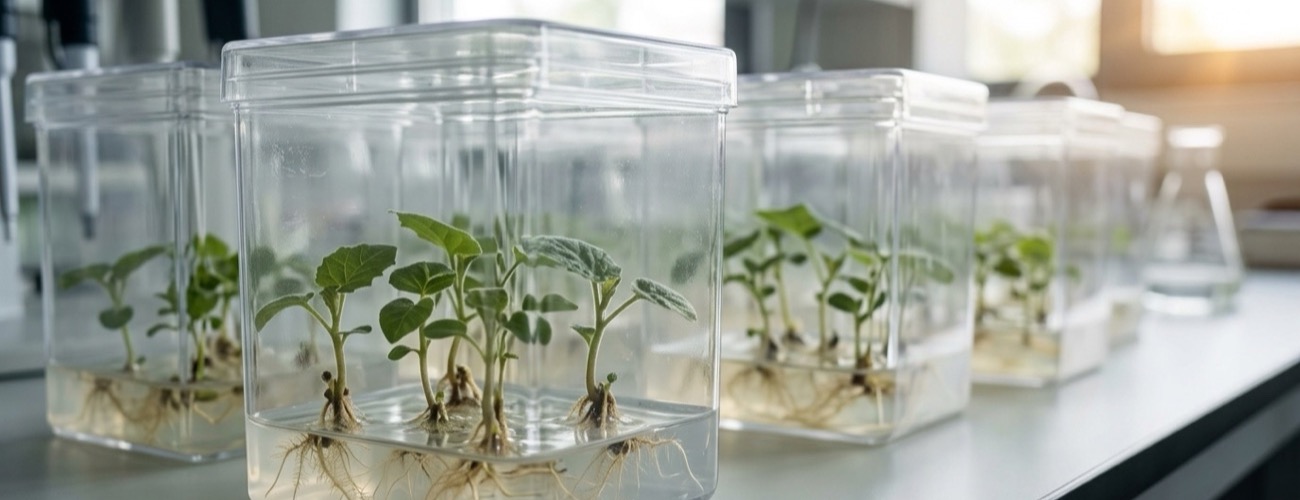
The format of the material matters as much as the paperwork. In vitro plantlets and semi-acclimatized plantlets are the most biosecure formats available: they are produced in sterile laboratory conditions, free of systemic pathogens, and packaged for transport in a way that minimises stress and contamination risk during international transit. This is the format in which the clone is supplied for international projects, and it is the format that Brazilian import inspections are best positioned to assess.
For how the plants are packed and travel from the laboratory to the client, see From Lab to Land: The Journey of Our Spring Deliveries.
- MAPA Normative Instruction No. 25 of 7 April 2020 conditions plant imports on phytosanitary requirements published in the Official Gazette, based on Pest Risk Analysis[5]
- Plants may only be imported if they appear on the List of Plant Products Authorized for Importation (PVIA)[5]
- Export documentation is issued by the Spanish laboratory under EU plant health standards, specifically Regulation (EU) 2016/2031
- In vitro and semi-acclimatized plantlets are the most biosecure supply format for international transit
Why clone selection decides plantation outcomes
Independent research confirms that the choice of plant material is decisive. A 2024 economic sustainability assessment of Paulownia farms in temperate climates found that profitability highly depends on the selection of plant species according to environmental conditions and the agricultural practices applied, and that several of the studied farms showed no profitability in the current economic situation and environmental conditions[6]. The same study concluded that selecting suitable Paulownia species for specific environmental conditions is a crucial factor for a profitable investment[6].
This is why the plant material itself, not just the supply channel, determines outcomes. The clone discussed here is a non-GMO hybrid of Paulownia elongata and Paulownia fortunei, selected in 2004 and reproduced in vitro from a single genotype. It produces sterile, non-viable seeds, which prevents spontaneous spreading and limits the invasion risks associated with other non-native species. It is also not listed as an invasive species in Spain under Real Decreto 630/2013.
The clone tolerates temperatures from -25 to +45 degrees Celsius, a range that maps directly onto the agroclimatic diversity a large country like Brazil presents, from subtropical southern states to tropical regions further north. This adaptability is the product of two decades of field trialling across multiple continents, not a projection.
The contrast with variable, non-registered hybrids is structural rather than rhetorical. Seed-grown Paulownia material produces severe phenotypic and structural variation, inconsistent growth rates, and unpredictable timber quality.
Sourcing Paulownia Clon InVitro 112® for Brazilian projects
Paulownia Clon InVitro 112® is the plant asset behind the supply channel described in this article. It offers Brazilian plantation programmes rapid growth, perfectly cylindrical trunks, and genetic uniformity across every plantlet, backed by over 20 years of field data and independent university testing. For a complete technical profile of the clone, including its timber properties, growth rates, and carbon sequestration capacity, see the complete guide to Paulownia Clon InVitro 112®.
Brazilian buyers engage through the exclusive country representative, Alex Weil (InVitro 112 Brasil), who coordinates access to certified plant material and local technical support for plantation projects in Brazil. His contact details are on the brand ambassadors and distributors page.
For professionals in other markets, the laboratory works with a carefully selected network of partners who share its long-term vision of sustainable forestry and responsible introduction of the clone into new markets. Organizations and individuals with proven experience in agriculture, forestry, distribution, or related sectors can explore collaboration through the brand ambassadors and distributors page, and inquiries submitted through the form receive a response within 24 hours[7].
- Professionals in other markets with proven agriculture, forestry, or distribution experience can explore collaboration via the brand ambassadors and distributors page[7]
- Inquiries submitted through the form receive a response within 24 hours[7]
Frequently asked questions
Who is the exclusive representative of the clone in Brazil?
Alex Weil is the exclusive representative of Paulownia Clon InVitro 112® in Brazil (www.invitro112.com). Access to the clone in Brazil runs through this one appointed representative rather than a network of resellers. Brazilian buyers sourcing certified plant material engage through that representative, who coordinates supply from the Spanish laboratory that produces the clone.
Is an exclusive distribution agreement valid under Brazilian law?
Yes. Article 711 of the Brazilian Civil Code presumes exclusivity in distribution and agency relationships unless the contract expressly states otherwise. Brazilian practice recognises exclusive, non-exclusive and selective distribution structures, and territorial exclusivity is expressly permitted.
Is the clone safe for Brazilian ecosystems?
It is a non-GMO hybrid of Paulownia elongata and Paulownia fortunei that produces sterile, non-viable seeds, so it cannot multiply spontaneously or spread uncontrolled. It is not listed as invasive in Spain under Real Decreto 630/2013 and is reproduced in vitro from a single registered genotype.
What certifications guarantee the plant material supplied to Brazil?
Every plant is produced under the SELECTOR-certified process held since 1990, when the Spanish laboratory became the first in the country to receive it. Production takes place in a registered nursery, each plant carries a phytosanitary passport, and genetic testing protocols are applied to detect market fraud, with legal consequences for unauthorised use of the trademark.
How large is the market for planted forests in Brazil?
Brazil's planted-tree area passed 10 million hectares for the first time, with eucalyptus alone accounting for 7.8 million hectares, or about 76 percent of the total. The country also targets restoring 12 million hectares of native vegetation by 2030 under Planaveg, with 3.4 million hectares already undergoing recovery as of 2025.
How can I become a distributor or representative in another country?
The laboratory welcomes inquiries from organizations and individuals with proven experience in agriculture, forestry, distribution or related sectors. The collaboration form on the brand ambassadors and distributors page is the first step, and submissions receive a response within 24 hours.