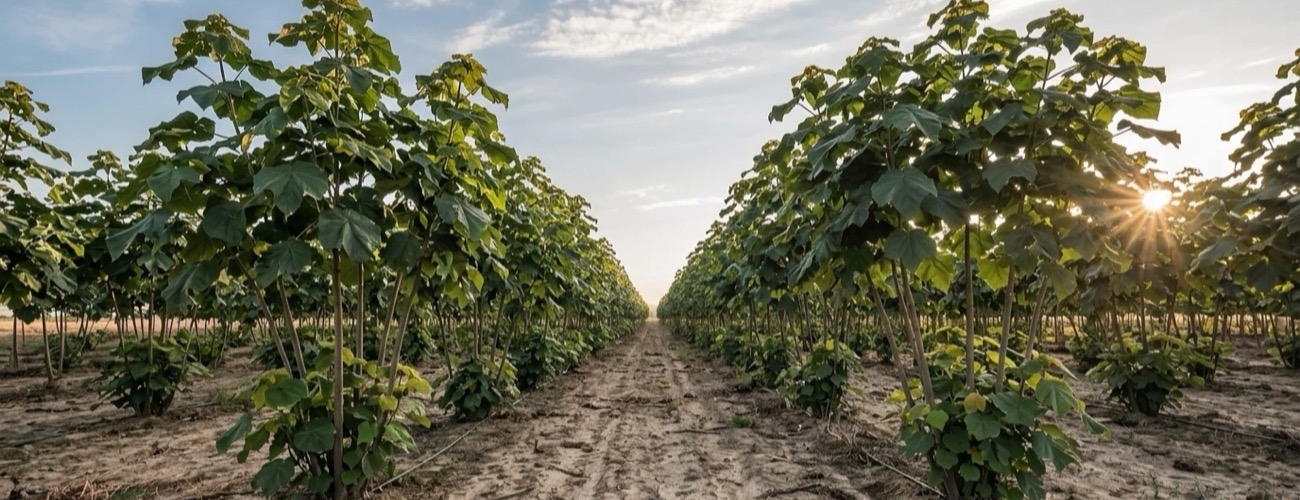
Paulownia Biomass: Yield, Calorific Value, and Coppicing
Learn Paulownia biomass yield per hectare, calorific value, and short-rotation coppicing cycles to optimize bioenergy production and plantation returns.
Why Paulownia Suits Short-Rotation Biomass Systems
At IN VITRO SL, our 35+ years of experience in plant tissue culture have demonstrated that short-rotation bioenergy crops require exceptional physiological efficiency to deliver consistent commercial returns. Paulownia stands out among fast-growing species due to its highly efficient photosynthetic pathway, which maximizes carbon assimilation and water-use efficiency relative to conventional forestry species. This metabolic mechanism drives rapid juvenile stem elongation, broad leaf-area index development, and fast canopy closure, positioning Paulownia as a highly effective bioenergy crop for fuel production.
However, wild species and non-registered seed selections exhibit high genetic variability, leading to irregular field survival and inconsistent wood densities. To solve these commercial limitations, our laboratory in Barcelona micropropagated Paulownia Clon InVitro 112® (widely recognized in environmental markets as the Oxytree). This non-GMO, fast-growing hybrid of Paulownia elongata and Paulownia fortunei is cloned in vitro from a single selected genotype. Unlike uncertified hybrids, this registered elite clone guarantees absolute genetic stability, high disease tolerance, and uniform development across short-rotation biomass plantations.
- Highly efficient photosynthetic activity that drives superior dry-matter accumulation and energy conversion rates.
- Sterile, non-invasive genetic profile that produces non-viable seeds, preventing ecological disruption.
- Complete genetic uniformity that eliminates field variability and standardizes harvest cycles.
- Certified virus-free tissue culture origin backed by strict phytosanitary and laboratory quality controls.
By deploying genetically stable, micropropagated elite clones rather than variable seedling stock, commercial growers establish a reliable foundation for sustainable short-rotation forestry.
Dry Biomass Yield per Hectare and Planting Density
Establishing short-rotation woody energy crops requires a precise balance between spatial distribution and light interception to maximize dry-matter accumulation. In commercial bioenergy plantations, our standard cultivation framework relies on a highly dense planting grid specifically optimized for short-rotation biomass harvest. Under this layout, Paulownia Clon InVitro 112® achieves significant dry-matter yields annually. Multi-site experimental trials across diverse agroclimatic zones in Spain demonstrate high annual productivity ranges under managed short-rotation schemes.
Cultivation Models and Productivity Benchmarks
Yield variations across Mediterranean and temperate climate zones depend directly on soil characteristics, irrigation regimes, and nutrient availability. While standard rainfed or low-input conditions produce baseline yields, optimal fertigation and intensive silvicultural management elevate annual dry-matter accumulation toward the upper genetic threshold. Fast-growing short-rotation woody species across Mediterranean Europe demonstrate high biomass yield variability depending on taxa selection and local edaphoclimatic management.
| Management Framework | Planting Grid (m) | Density (Trees/Ha) | Harvest Cycle | Annual Dry Biomass Yield |
|---|---|---|---|---|
| Short-Rotation Biomass (Standard) | 3 x 2 | 1,666 | 2-3 Years | 30-50 Tm/Ha |
| High-Input Bioenergy System | 3 x 2 | 1,666 | 2 Years | 40-50 Tm/Ha |
| Timber Production Framework | 5 x 5 | 400 | 8-9 Years | 1 m³/tree |
By maintaining strict clonal uniformity through in vitro micropropagation, every stem within the 3x2 meter grid develops at an identical rate. This architectural consistency eliminates inter-tree competition imbalances common in seed-derived stands, ensuring predictable biomass volume during mechanized harvests.
Calorific Value and Combustion Fuel Quality
As a pioneering plant biotechnology laboratory with over 35 years of experience, we have evaluated numerous bioenergy species to establish rigorous energy benchmarks. When processed into direct combustion chips or industrial pellets, Paulownia Clon InVitro 112® serves as a highly efficient bio-energy crop across Europe. Its chemical composition yields a high gross calorific value that reliably outperforms standard agricultural residue and conventional agro-industrial biomass subproducts.
| Feedstock Parameter | Paulownia Clon InVitro 112® | Standard Agro-Biomass |
|---|---|---|
| Gross Heating Value | High | Moderate |
| Ash Content | Very Low | Moderate to High |
| Corrosive Chlorine Content | Very Low | Moderate to High |
| Emission Profile (N, S) | Minimal SOx / NOx | Variable / Higher |
Beyond thermal potential, combustion safety and equipment longevity depend heavily on mineral purity. Laboratory analyses published in our scientific data records confirm that wood from Paulownia Clon InVitro 112® exhibits exceptionally low ash generation, minimal corrosive chlorine levels, and reduced carbon, nitrogen, and sulfur emissions during combustion. Low chlorine prevents high-temperature slagging and boiler tube corrosion, whereas low ash formation reduces furnace maintenance cycles for commercial thermal power operators.
For commercial growers and industrial fuel producers, these physical and thermochemical attributes position Paulownia Clon InVitro 112® as a premium solid biofuel. The uniform wood structure ensures consistent drying kinetics and pelletization efficiency, delivering a high-grade energy product that complies with strict European bioenergy emission standards.
Coppicing Cycles and Regrowth Management
Short-rotation coppicing (SRC) leverages the high vegetative vigor and rapid resprouting capacity of the genus Paulownia. When cultivated under a dedicated bioenergy framework, trees are harvested on a short rotation cycle. Unlike annual energy crops or traditional forestry systems that require clear-cutting and ground re-preparation, established short-rotation woody crops rely on an expansive subterranean root system to drive immediate post-harvest regeneration. This physiological mechanism eliminates re-planting expenditure and soil disturbance across multiple harvesting cycles.
Through our micropropagation protocols perfected over 35+ years of laboratory operations, Paulownia Clon InVitro 112® provides complete genetic stability. In seed-propagated plantations, multi-stem regrowth often suffers from genetic segregation, structural asymmetry, and high shoot mortality. In contrast, our in vitro selected non-GMO hybrid (Paulownia elongata × Paulownia fortunei) exhibits exceptional physiological uniformity during coppicing, channeling root reserves evenly into rapid vertical shoots that maximize total dry-matter volume per hectare.
- Standard Planting Grid: A high-density cultivation framework designed specifically for maximum woody biomass yield.
- Harvest Frequency: Rotational short-term cuts executed during winter dormancy when carbohydrate reserves in the root mass are highest.
- Biomass Productivity: Sustained high yields of dry matter per hectare per year under optimal irrigation and agroclimatic management.
- Stump Longevity: Multi-decadal root vitality permitting repeated coppicing cycles without requiring rootstock replacement or density loss.
By deploying micropropagated single-genotype clones, commercial growers secure predictable yield kinetics across successive rotations. Scientific field data confirms that the well-anchored root architecture established during the first two seasons functions as an active biological reserve, accelerating stem elongation immediately following each coppicing event.
Biomass vs Timber: Comparing Strategic Management Models
When establishing a commercial forestry project, growers must align planting density and harvest schedules with the intended industrial end-use. At IN VITRO SL, our micropropagation laboratory in Barcelona has spent over 35 years refining execution protocols for both short-rotation bioenergy crops and high-value timber plantations using Paulownia Clon InVitro 112®. Selecting between a short-rotation coppice model and a long-rotation timber model alters spatial layout, capital cash flow, and final wood properties.
| Parameter | Short-Rotation Biomass Model | Industrial Timber Model |
|---|---|---|
| Planting Density | High-density spacing | Standard timber spacing |
| Harvest Cycle | Short-term coppicing cycles | Extended growth to maturity |
| Yield Potential | High annual biomass volume | High-grade structural timber |
| Primary End-Use | Biofuel pellets and direct combustion | Structural lumber and furniture |
| Capital Cash Flow | Frequent short-term returns | Deferred return at maturity |
Short-rotation management prioritizes maximum green volume per hectare. High-density 3x2 meter grids encourage rapid vertical growth and frequent coppicing, generating consistent feedstock for thermal bioenergy plants. In contrast, timber management relies on a 5x5 meter layout to maximize radial trunk expansion. Under this extended cycle, trees reach an average diameter at breast height (DBH) of 32 cm by year 7, producing stable lumber with a dry density of approximately 237 kg/m³ to 310 kg/m³. This lightweight structural timber, known in industrial manufacturing as 'aluminium timber,' yields high financial returns in specialized carpentry, shipbuilding, and modular construction.
Because Paulownia Clon InVitro 112® is a non-GMO, genetically uniform hybrid selected in 2004, both management systems benefit from identical physiological advantages: rapid C4 photosynthetic efficiency, robust root system preservation post-harvest, and uniform clonal regrowth across successive cycles. Whether growers optimize for early cash flow through energy biomass or long-term value through technical timber, starting with disease-free tissue culture stock ensures predictable field performance.
Agronomic and Site Requirements for Biomass Success
Establishing a high-yield short-rotation woody biomass plantation requires strict attention to soil physical properties and climate dynamics. Optimal development of Paulownia Clon InVitro 112® occurs in permeable, well-drained soils with a pH ranging between 5.0 and 8.9. As a non-GMO, C4 photosynthesis pathway hybrid derived from Paulownia elongata and Paulownia fortunei, this registered clone exhibits exceptional thermal resilience, surviving ambient conditions from -25 °C to +45 °C. However, stagnant water and clay-heavy, poorly drained soils present severe risks of root hypoxia, leading to reduced growth velocity or complete crop failure.
Early-Stage Establishment and Weed Management
The initial 24 months after field transplanting represent the critical window for plantation success. During this juvenile growth phase, young micropropagated plantlets require rigorous weed control and balanced irrigation to prevent resource competition. Because juvenile Paulownia plants feature large surface leaves and unthickened stems, effective wind mitigation and precise soil moisture management are essential. In our 35+ years of micropropagation experience since 1986, we have verified that proper post-transplant care allows the root system to establish deeply, ensuring homogeneous vigor across the entire planting grid.
- Soil Permeability & Drainage: Deep, porous sandy-loam soils with water tables deeper than 1.5 meters to prevent root waterlogging.
- Soil Reaction: Optimal growth between pH 5.5 and 7.5, with tolerance spanning pH 5.0 to 8.9.
- Thermal Tolerance: Tested operational range from -25 °C in winter dormant periods up to +45 °C during active summer vegetation.
- Critical 24-Month Management: Total mechanical or chemical weed exclusion within a 1-meter radius around each plant, combined with drip irrigation during the initial establishment year.
By aligning precise site selection with standardized field management protocols, growers mitigate early establishment risks and secure maximum dry-matter accumulation for subsequent short-rotation harvest cycles.
Ecological and Operational Integration for Bioenergy Producers
Beyond direct thermal energy yields, establishing short-rotation woody biomass plantations with Paulownia Clon InVitro 112® delivers documented environmental and multi-stream economic benefits. As a fast-growing C4 photosynthesis pathway hybrid of Paulownia elongata and Paulownia fortunei, our proprietary clone exhibits superior photosynthetic efficiency and carbon sequestration, absorbing up to 111 tons of CO2 per hectare annually. Crucially, research project PBI06-0161 conducted by Castilla La Mancha University verified that the hybrid produces non-viable, sterile seeds. This ecological safeguard prevents spontaneous dissemination into surrounding habitats, confirming that Paulownia Clon InVitro 112® is non-invasive and compliance-tested under Spanish Real Decreto 630/2013[1].
In addition to atmospheric carbon capture, the physiological architecture of the tree supports active soil recovery and phytoremediation. The extensive root network exhibits high tolerance to toxic soil elements while efficiently translocating key nutritional and trace elements, including boron, calcium, potassium, phosphorus, rubidium, rhenium, and tantalum. Deep root penetration stabilizes topsoil and draws subsoil nutrients to the surface layer, enhancing overall land vitality across consecutive coppicing cycles.
- Certified Carbon Offset Programs: Monetize verified carbon removal through international carbon markets, leveraging measured annual CO2 sequestration rates.
- Complementary Honey Production: Abundant spring blossoms generate high-quality honey, providing an estimated secondary yield of around 700 kg of honey per hectare.
- Phytoremediative Soil Regeneration: Absorb and translocate critical minerals while stabilizing degraded soils across multi-year coppicing rotations.
Through 35+ years of micropropagation experience since our founding in 1986 in Barcelona, Spain, we ensure that every delivered plantlet maintains strict genetic uniformity. By integrating biomass harvesting with certified carbon credits and apiary diversification, commercial bioenergy producers maximize overall land returns while maintaining rigorous ecological compliance.
Frequently asked questions
What is the expected biomass yield per hectare for Paulownia?
Under short-rotation management at a high planting density, Paulownia Clon InVitro 112® produces significant volumes of dry biomass per hectare per year, depending on soil quality, irrigation, and local climate.
What is the calorific value of Paulownia biomass?
Paulownia wood has a competitive high calorific value, making its heat output superior to many agricultural residues and highly competitive with traditional hardwood fuels.
How often can Paulownia be harvested for biomass?
Paulownia biomass plantations operated under a short-rotation coppicing system are typically harvested on short-term cycles. After each harvest, the established root system produces rapid, uniform multi-stem shoot regrowth without requiring land re-preparation or replanting.
How does biomass management differ from timber cultivation?
Biomass management uses high-density planting and short coppicing cycles for wood chips or pellets. Timber management uses wider spacing and extended growth cycles to produce large, single-stem cylindrical logs for industrial timber.
Is Paulownia Clon InVitro 112® invasive in bioenergy plantations?
No, Paulownia Clon InVitro 112® is a non-GMO hybrid that produces non-viable, sterile seeds. It cannot spread spontaneously into surrounding ecosystems and is compliant with European regulations regarding non-invasive tree species.