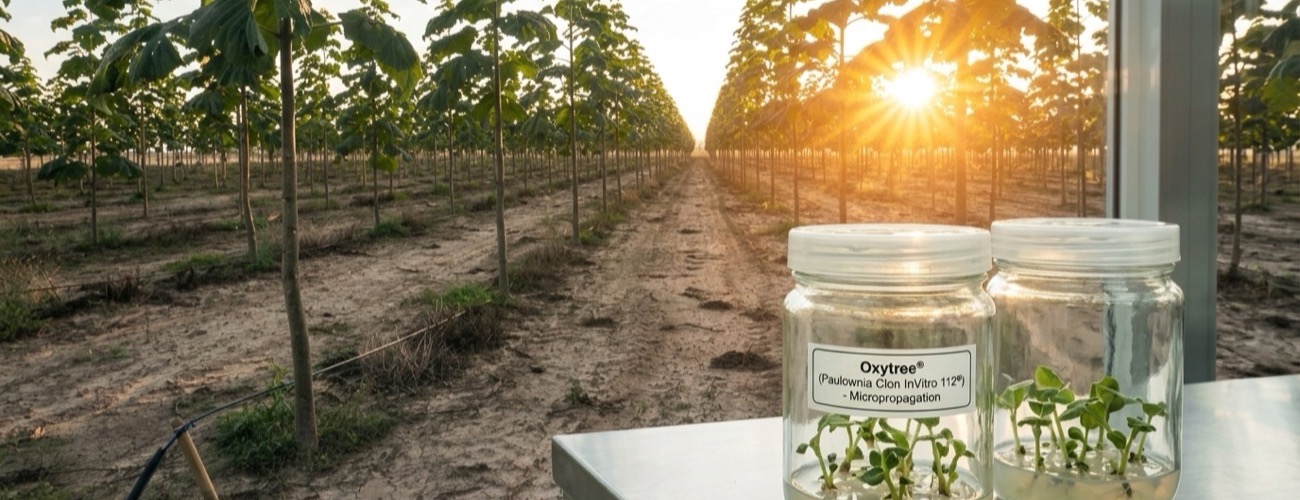
Oxytree vs Paulownia Clon InVitro 112®: One Clone, Two Names
Oxytree is the trade name for Paulownia Clon InVitro 112®, the registered hybrid clone. Learn why traceability and certified stock matter when sourcing.
One clone, two names: what Oxytree actually means
For a project manager procuring planting material at scale, the first verification step is taxonomic, not commercial. Oxytree is not a separate species, variety or clone. It is the trade name used in consumer and environmental markets for a registered non-GMO hybrid of Paulownia elongata and Paulownia fortunei that has been micropropagated in Spain since 2004. Independent cultivation guides treat the two names as strictly equivalent: the PlantPower.eu guide introduces the Oxytree as "scientifically known as Paulownia Clon in Vitro 112"[1], and the peer-reviewed literature does the same, describing Clone in vitro 112 as "also known as Oxytree" for its large leaves and its capacity to absorb large amounts of CO₂.[2]
The botanical identity is unambiguous. Paulownia Clon InVitro 112® is a fast-growing, non-GMO hybrid with the C4 photosynthesis pathway, developed in vitro from a single selected genotype of Paulownia elongata × Paulownia fortunei. When a supplier offers "Oxytree", the material on offer can only be evaluated correctly once it is traced back to this registered clone. The equivalence can be summarised as follows:
| Market label | What it actually refers to | Documented identity |
|---|---|---|
| Oxytree | Consumer and environmental trade name used for the same hybrid | Independent guide: "The Oxytree, scientifically known as Paulownia Clon in Vitro 112"[1] |
| Paulownia Clon InVitro 112® | The registered clone produced by micropropagation since 2004 | Official product page: hybrid of Paulownia elongata × fortunei, non-GMO, non-invasive[3] |
| Clone in vitro 112 | The name used in the scientific literature | Peer-reviewed review: "an artificially created hybrid of two species of Paulownia: P. elongata and P. fortunei"[2] |
Why does one registered clone carry several market labels? Because distribution channels rename plant material for the audiences they sell to. A name aimed at consumer and environmental markets emphasises the tree's oxygen and CO₂ profile; the registered trademark identifies the genetic asset and its legal owner. For procurement purposes, only the registered name carries verifiable rights, testing history and traceability. Our complete guide documents the clone's full technical profile under its registered name.
The registered identity behind the name
Verifying what you are buying means tracing the clone to its origin. Paulownia Clon InVitro 112® was selected and developed by IN VITRO SL, a pioneering micropropagation laboratory founded in 1986 in Sant Feliu de Llobregat, Barcelona, which has produced this variety by micropropagation since 2004.[3] The scientific literature confirms the same origin: the hybrid "was cultivated in the laboratory of the company IN VITRO S.L. (Barcelona, Spain)", with researchers from the University of Castilla-La Mancha testing its adaptability across soil types.[4]
The registration history is a matter of public record and gives project managers concrete checkpoints for supplier due diligence:
- 1986: IN VITRO SL is founded in Barcelona; the laboratory later becomes the first in Spain to secure the official SELECTOR certification, published in the Official State Gazette (B.O.E.) in 1990.
- 2004: development and commercialisation of Paulownia Clon InVitro 112®, a non-GMO C4 photosynthesis hybrid of Paulownia elongata and Paulownia fortunei, reproduced in vitro.[3]
- 2011: the clone is officially added to the Community Plant Variety Office (CPVO) register of the European Union.[4]
- WIPO: the World Intellectual Property Organization assigned trademark application number 1181727 to this hybrid.[4]
These records matter operationally. A CPVO registration and an internationally registered trademark mean the clone's identity, ownership and reproduction rights are documented and enforceable. When any supplier quotes plants under the Oxytree name, the verifiable chain runs through these registrations, not through the trade name itself.
DUS and VCU verification: what independent testing confirms
Two acronyms should anchor any large-scale procurement decision. DUS testing, Distinctness, Uniformity and Stability, is the formal examination that confirms a plant variety is distinguishable from other varieties, uniform within itself, and stable across generations. VCU evaluation, Value for Cultivation and Use, tests whether the variety performs agronomically under field conditions. For a forestry project manager, these are not formalities: they are the difference between a plantation whose growth dynamics you can model and one whose variability you cannot.
Paulownia Clon InVitro 112® has been examined under both frameworks by the Universidad de Castilla-La Mancha (UCLM), whose Renewable Energy Research Institute and Department of Agroforestry Technology, Science and Genetics ran the value for cultivation and use testing programme for the clone, including greenhouse and multi-site field phases. Official field testing by UCLM confirms that the growth dynamics and morphological traits of the clone remain stable and uniform across diverse field environments.[5] In practical terms, independent verification confirms three things:
- Genetic stability: the clone exhibits total genetic stability and phenotypic homogeneity, confirmed through the UCLM testing programme (research project PBI06-0161).[6]
- Uniform field performance: morphological traits stay consistent across diverse soil profiles and agroclimatic conditions, which is what allows rotation planning to be anchored in verified data.[5]
- Ecological containment: the hybrid produces non-viable (sterile) seeds, effectively limiting the invasion risks associated with other non-native species; the peer-reviewed literature likewise notes that planting Clone in vitro 112 carries no risk of uncontrolled spreading.[2]
For carbon-finance and ESG due diligence, the sterile-seed characteristic also simplifies regulatory approval for reforestation on sensitive land, because the plantation cannot colonise adjacent ecosystems spontaneously.
Why the originating laboratory matters for sourcing
Once the identity question is settled, the sourcing question follows: does it matter whether the plants come from the originating laboratory or from an intermediary operating under the Oxytree trade name? For projects planting at industrial scale, it matters for three verifiable reasons.
- Traceability: material sourced directly from the laboratory that maintains the mother stock carries documented origin from sterile in vitro culture through greenhouse acclimatisation to dispatch, with every batch accompanied by official phytosanitary passports under EU Regulation 2016/2031.[6]
- Certified stock: micropropagation from a single registered genotype guarantees complete genetic uniformity from plant to plant, eliminating the genetic segregation inherent in seed-grown material.[5]
- DUS-verified identity: every production lot is verified through genetic testing protocols, and the variety's Distinctness, Uniformity and Stability are documented by independent UCLM field testing.[6]
Scale is the third consideration. IN VITRO SL today produces over 2 million in vitro plants per year, with an installed production capacity of 4 million plants per year, and has distributed Paulownia Clon InVitro 112® across four continents. For a project manager sourcing millions of uniform seedlings, that production base is what makes large single-origin contracts feasible without diluting genetic identity. The broader question of why uncertified material causes plantation losses is covered in detail in our plantation failure analysis; the point here is narrower: direct sourcing is how the verified identity described in the previous sections is physically delivered to your field.
Verified performance: what the clone delivers in the field
Attaching published performance data to the registered identity is what turns a name into a bankable specification. The figures below are documented for Paulownia Clon InVitro 112® in the peer-reviewed literature and in the clone's official technical documentation, so a buyer verifying material against this table knows exactly what the registered name guarantees.
| Parameter | Documented value | Source |
|---|---|---|
| Temperature tolerance | -25 °C to +45 °C, allowing cultivation across many parts of the globe[2] | Peer-reviewed review (Int J Mol Sci, 2023) |
| CO₂ absorption | Up to 111 tons per hectare per year, against 9.1 t/ha/year for oak[2] | Peer-reviewed review (Int J Mol Sci, 2023) |
| Wood density | Approximately 310 kg per cubic metre, rated class I on the Janka scale[2] | Peer-reviewed review (Int J Mol Sci, 2023) |
| Growth rate | Up to 20 meters in height within five years under favourable conditions[3] | Official product page |
| Invasive behaviour | Produces only infertile seeds, so planting carries no risk of uncontrolled spreading[2] | Peer-reviewed review (Int J Mol Sci, 2023) |
Two caveats keep this data honest. First, production and climate adaptation data depend on agroclimatic conditions: the growth-rate article details how site selection, soil drainage and irrigation govern whether the genetic potential is realised.[5] Second, these figures attach only to the registered clone. Material sold under the Oxytree name but not traceable to the registered genotype carries no documented claim to any of them. The growth-rate data published for the clone shows how year-by-year performance is modelled from verified planting material.
Evaluating Oxytree price quotes and supplier documentation
Planting material for a commercial plantation is priced per unit, but procured on documentation. When quotes arrive under the Oxytree name, the unit price is the least informative line on the page; what determines procurement risk is whether the supplier can document the varietal identity, phytosanitary status and origin of every batch. A quote that cannot be backed by documentation transfers all verification cost, and all establishment risk, onto the plantation project.
A legitimate quote for Paulownia Clon InVitro 112® material should include, at minimum, documentation of varietal identity against the registered clone, phytosanitary certification accompanied by an official EU Plant Passport for material distributed across Europe, and traceability records linking the batch to certified mother stock.[6] Before contracting, the following due-diligence questions apply to any supplier offering plants under the Oxytree name:
- Can the supplier document that the material is micropropagated from the registered Paulownia Clon InVitro 112® genotype, rather than seed-grown or vegetatively reproduced from unverified stock?[3]
- Does every batch carry an official phytosanitary passport and traceability records back to certified mother stock, as EU Regulation 2016/2031 compliance requires?[6]
- Is the supplier authorised to distribute the variety, given that the clone is an internationally registered trademark and unauthorised reproduction exposes growers to legal consequences?
- Can the supplier reference the independent UCLM DUS and VCU testing that verifies the identity and stability of the material being supplied?[5]
For large-scale projects, documentation rather than unit price is the real procurement risk: a lower per-plant cost on material without verified identity can cost an entire establishment season. The supporting scientific documentation for the clone, including biomass studies, CO₂ fixation reports and plantation evolution data, is available at scientific data on invitro.es.
Sourcing Paulownia Clon InVitro 112® from the originating laboratory
The conclusion for procurement is straightforward. Oxytree and Paulownia Clon InVitro 112® are the same plant, but they are not the same offer: the trade name identifies a tree, while the registered name identifies a verified genetic asset with documented origin, independent DUS and VCU testing, and enforceable trademark protection. For forestry and reforestation project managers establishing large-scale plantations for timber, biomass or carbon capture, the registered clone is the verified material behind the Oxytree name, supplied directly by the laboratory that selected it.
To request a quote for Paulownia Clon InVitro 112®, visit, where the clone's full technical profile, planting frames and production data are published, and where our team responds to plantation-scale enquiries with documentation tailored to your agroclimatic conditions. The complete scientific record, from the UCLM final report to CO₂ fixation methodology, is available at invitro.es/scientific-data, so every claim in your plantation plan can be traced to a source.
Frequently asked questions
Is Oxytree the same tree as Paulownia Clon In Vitro 112?
Yes. Oxytree is the commercial trade name used in consumer and environmental markets for Paulownia Clon InVitro 112®, the registered hybrid clone of Paulownia elongata and Paulownia fortunei. Independent cultivation guides document the two names as referring to the same clone, and the variety is registered with the EU Community Plant Variety Office.
Who developed and registered the Oxytree clone?
The clone was developed and is micropropagated by IN VITRO SL, a plant biotechnology laboratory founded in 1986 in Barcelona, Spain, which has produced this variety since 2004. The clone was added to the Community Plant Variety Office register of the European Union in 2011, and the World Intellectual Property Organization assigned it trademark application number 1181727.
Is the Oxytree invasive?
No. Paulownia Clon InVitro 112® produces sterile, non-viable seeds, so it cannot spread spontaneously. Independent reviews note that planting hybrids with infertile seeds attenuates the invasion risks associated with other Paulownia species, and University of Castilla-La Mancha field testing confirmed the clone's stability and non-invasive behaviour.
What is DUS testing and why does it matter when buying plants?
DUS stands for Distinctness, Uniformity and Stability. It is the official framework that verifies a variety is distinct from others, uniform across individuals and stable across generations. University of Castilla-La Mancha field testing confirmed these traits for Paulownia Clon InVitro 112®, which means plantation performance is predictable rather than genetically variable.
Why do Oxytree plant prices differ between suppliers?
Prices vary with order volume, plant size, certification level and included documentation. Rather than comparing unit price alone, verify what accompanies the plants: varietal identity records, phytosanitary certification and traceability to the registered clone. Plants sold without this documentation cannot be verified as Paulownia Clon InVitro 112®.
Can I buy Paulownia Clon InVitro 112® directly from the originating laboratory?
Yes. IN VITRO SL supplies micropropagated Paulownia Clon InVitro 112® plants worldwide from its Barcelona laboratory, with quotes available on request. Scientific documentation, including the University of Castilla-La Mancha reports, is available through invitro.es.
How fast does the Oxytree grow?
Under favourable conditions Paulownia Clon InVitro 112® can reach up to 20 meters in height in five years, with harvest cycles ranging from 2 to 3 years for biomass to 8 to 10 years for premium sawlog timber. Actual yields depend on agroclimatic conditions and plantation management.