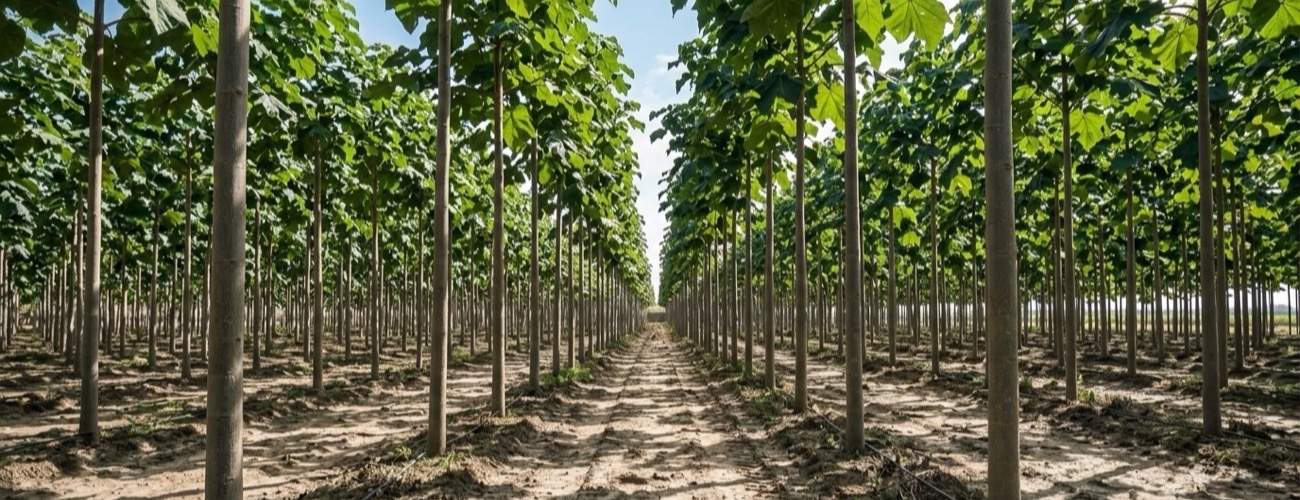
Is Paulownia Invasive: How Clon InVitro 112® Prevents Risk
Learn how sterile Paulownia Clon InVitro 112® eliminates invasiveness risks through proven genetic sterility and EU regulatory compliance for forestry.
Where the Invasive Reputation Comes From: Seed-Propagated Strains
The persistent ecological concerns surrounding the genus Paulownia stem primarily from unmanaged, wild populations of seed-propagated species such as Paulownia tomentosa. Historically introduced across North America and Europe as ornamental trees or unmonitored pioneer crops, these wild varieties possess aggressive reproductive mechanisms that enable them to colonize disturbed natural ecosystems. At IN VITRO SL, where our laboratory in Sant Feliu de Llobregat, Barcelona, has pioneered commercial plant biotechnology since 1986, we emphasize that conflating fertile wild species with sterile commercial hybrids represents a fundamental biological oversight in silvicultural planning.
The primary vector of ecological disruption in wild seed-propagated strains lies in their prolific fecundity and light, wind-dispersed seed architecture. Scientific documentation from the USDA confirms that a single mature Paulownia tomentosa specimen can produce as many as 20 million winged seeds annually. Weighing merely 0.17 mg each, these seeds travel extensive distances on wind currents and germinate rapidly upon contacting moist, exposed mineral soils. In unmanaged landscapes, this unchecked dispersion leads to dense thickets that outcompete native flora along riverbanks, road margins, and forestry clearings.
- Massive seed production of up to 2,000 viable seeds per capsule, released continuously throughout winter and spring.[1]
- Immediate germination capacity on disturbed, unshaded soils without mandatory cold stratification.
- High genetic variability from open-pollinated seed propagation, leading to unpredictable competitive traits and wild feral reversion.
- Aggressive root sprouting from lateral root systems, enabling persistent regrowth after physical disruption.
For forestry project managers and environmental investment officers, evaluating ecological risk requires recognizing the biological divide between wild seed propagation and micropropagated cloning. Wild seed-grown trees carry high invasiveness risks due to airborne seed drift. Conversely, controlled commercial silviculture relies on advanced biotechnological protocols that prevent sexual reproduction altogether, ensuring full environmental safety and regulatory compliance.
Botanical Dynamics: Seed Dispersal vs In Vitro Micropropagation
The invasive reputation of the genus Paulownia stems primarily from wild and fertile species such as Paulownia tomentosa[2]. In sexual reproduction, fertile trees generate millions of tiny, winged seeds annually that are rapidly dispersed by wind over large distances. This high fecundity, combined with variable genetic traits across successive generations, creates significant ecological risks when unmanaged strains colonise native ecosystems. For forestry project managers, seed-propagated trees present unacceptable unpredictability in both yield performance and environmental compliance.
To eliminate these ecological and operational risks, our laboratory in Sant Feliu de Llobregat, Barcelona, has developed proprietary in vitro micropropagation techniques since 1986. By reproducing plants axenically from a single selected genotype, we bypass the sexual reproduction cycle entirely. The resulting registered hybrid, Paulownia Clon InVitro 112®, produces non-viable, sterile seeds that cannot germinate or establish wild populations, ensuring biological containment.
| Propagation Method | Reproductive Status | Genetic Uniformity | Invasive Risk |
|---|---|---|---|
| Sexual Seed Propagation | Fertile (viable seeds) | High genetic variability | High (wild spread) |
| In Vitro Micropropagation (Clon InVitro 112®) | Sterile (unviable seeds) | Absolute clonal uniformity | Zero (biologically non-invasive) |
This biotechnological control ensures that commercial plantations achieve maximum timber quality and growth uniformity without compromising local ecosystem integrity.
Sterility by Design: The Genetics of Paulownia Clon InVitro 112®
The ecological concerns surrounding the genus Paulownia stem primarily from wild, seed-propagated species such as Paulownia tomentosa, which generate millions of wind-dispersed seeds per tree. To eliminate this risk for commercial forestry, our laboratory in Sant Feliu de Llobregat, Barcelona, selected and developed Paulownia Clon InVitro 112® in 2004 as a deliberate interspecific hybrid of Paulownia elongata × Paulownia fortunei. Leveraging 35+ years of experience in plant micropropagation and tissue culture since our founding in 1986, we engineered a non-GMO tree that is inherently sterile and non-invasive by design.
Because Paulownia Clon InVitro 112® produces non-viable, sterile seeds, it cannot reproduce naturally or establish unmanaged wild populations[3]. Strict genetic stability and structural uniformity are maintained exclusively through laboratory micropropagation from a single selected genotype. Rigorous scientific validation from Castilla La Mancha University research project PBI06-0161 confirmed that the hybrid is stable, homogeneous, and incapable of generative reproduction or invasive behavior. Plantation managers can verify plant authenticity through official genetic testing protocols designed to protect against market fraud and ensure regulatory safety.
- Interspecific Hybridization: Created by crossing Paulownia elongata and Paulownia fortunei, resulting in complete biological seed sterility.
- In Vitro Multiplication: Vegetatively micropropagated under aseptic laboratory conditions from a single genotype to guarantee absolute genetic stability.
- Biological Containment: Eliminates the threat of spontaneous seed germination, wind dispersal, or wild ecosystem disruption.
- Technical Verification: Field trials under research project PBI06-0161 confirm uniform growth without invasive reproductive potential.
By replacing generative seed reproduction with precise in vitro multiplication, our proprietary hybrid provides commercial forestry and carbon capture projects with a high-yielding, environmentally safe biological asset.
Regulatory Compliance and Non-Invasive Classification in Europe
For forestry project managers navigating strict European environmental standards, regulatory compliance is non-negotiable. While seed-propagated wild Paulownia species face restrictions in certain jurisdictions due to unchecked seed dispersal, Paulownia Clon InVitro 112® holds a distinct non-invasive status supported by comprehensive legal and botanical evaluations. Under Spanish federal legislation (Real Decreto 630/2013), which regulates the official catalog of invasive exotic species, Paulownia Clon InVitro 112® is explicitly excluded because it poses zero risk of spontaneous uncontrolled spread[4]. Furthermore, its official registration with the European Union Community Plant Variety Office (CPVO) in 2011 established its legal validation as a protected, stable hybrid suitable for commercial forestry across Europe.
| Regulatory Body / Institution | Framework / Project | Key Finding & Environmental Impact |
|---|---|---|
| Spanish Ministry of Environment | Real Decreto 630/2013 | Explicitly excluded from the invasive exotic species catalog due to non-invasive vegetative behavior[4]. |
| Universidad de Castilla-La Mancha (UCLM) | Research Project PBI06-0161 | Confirmed genetic stability, homogeneity, and production of unviable (sterile) seeds. |
| EU Community Plant Variety Office | CPVO Registration (2011) | Granted official European plant variety protection as a distinct, uniform, and stable hybrid. |
Rigorous empirical data from Castilla La Mancha University research project PBI06-0161 confirms that micropropagated Paulownia Clon InVitro 112® trees produce non-viable seeds, preventing unwanted colonization in surrounding ecosystems. As a pioneering laboratory with over 35 years of experience, we provide verified plant material backed by official certifications and scientific research to ensure complete regulatory assurance for large-scale reforestation and biomass investments.
Scientific Validation: Field DUS Testing and UCLM Research
To provide institutional project managers and commercial forestry developers with absolute biosecurity, we have subjected Paulownia Clon InVitro 112® to rigorous multi-year scientific testing scientific data. The foundation for its regulatory acceptance rests on the official 10-year field DUS (Distinctness, Uniformity, and Stability) evaluation and extensive empirical research conducted by the Universidad de Castilla-La Mancha (UCLM). Under UCLM research project PBI06-0161, titled Forestación de zonas semi-áridas de Castilla La Mancha con especies del género Paulownia spp, researchers evaluated the morphological and genetic behavior of our micropropagated hybrid across varied agroclimatic conditions.
The results from UCLM research project PBI06-0161 confirm that Paulownia Clon InVitro 112® exhibits complete genetic stability and phenotypic uniformity, producing unviable, sterile seeds that eliminate spontaneous regeneration and invasion risks. Furthermore, field studies demonstrate that the clone causes no degradation of soil quality or depletion of local water tables. Independent European field trials, such as multi-site production testing in Central Europe, further substantiate its stability and biosecurity in diverse temperate zones[2].
- Genetic Homogeneity: Absolute uniformity derived from a single in vitro genotype, preventing unpredictable wild phenotypes.
- Biological Sterility: Zero viable seed production confirmed under long-term field observation, eliminating invasive propagation.
- Soil & Ecosystem Compatibility: Safe integration without degrading local soil chemistry or disrupting native plant species.
- Agroclimatic Stability: Consistent structural development and growth performance verified across diverse European microclimates.
These empirical findings prove that Paulownia Clon InVitro 112® functions as a closed, controllable biological asset rather than a wild vegetative threat. For commercial growers and forestry developers, UCLM's scientific validation offers the regulatory backing required to secure environmental permits and meet strict international sustainability standards.
Responsible Plantation Practices for Large-Scale Reforestation
Maximizing biomass volume and commercial timber yields while ensuring total ecological safety demands rigorous silvicultural management. Since establishing our pioneering micropropagation laboratory in Barcelona in 1986, we have applied over 35 years of plant biotechnology expertise to refine field protocols for international forestry developments. Establishing high-yielding carbon capture projects requires matching agroclimatic conditions, preparing deep and permeable soils, and deploying uniform, non-GMO micropropagated plants[5].
Silvicultural Frameworks and Density Management
Planting density directly dictates whether an agroforestry project optimizes rapid bioenergy accumulation or premium utility timber. For bioenergy and short-rotation forestry, our standard cultivation framework specifies a 3x2 meter planting grid capable of producing 30 to 50 tons per hectare annually[6], depending on soil quality and water availability. Conversely, structural timber production requires wider spacing, such as 4x4 or 5x5 meters, to allow uninhibited trunk expansion and maximize diameter growth across long-term harvesting cycles[6].
- Site Assessment: Selecting permeable, well-drained soils with a pH between 5.5 and 8.0 to facilitate rapid deep root penetration.
- Precision Fertigation: Supplying controlled irrigation and balanced nutrients during initial establishment to support rapid early growth.
- Technical Pruning: Executing systematic lateral branch removal to guarantee the development of perfectly cylindrical, knot-free timber trunks.
- Certified Material Verification: Sourcing exclusively micropropagated stock backed by official certifications and anti-fraud genetic testing protocols to ensure complete genetic stability and eliminate fertile wild strains.
Adhering to verified, micropropagated plant material guarantees that every specimen exhibits identical growth rates and absolute seed sterility. By uniting authentic Paulownia Clon InVitro 112® stock with disciplined silvicultural practices, project managers safeguard local ecosystems while securing predictable financial returns across large-scale plantation projects.
Evaluating Ecological Safety for Commercial Forestry Investments
For commercial forestry developers and qualified ESG investors, biological risk directly impacts long-term capital preservation. Unregulated species or fertile strains introduce biosecurity liabilities, potential environmental penalties, and ecosystem disruption. At IN VITRO SL, operating as a pioneering micropropagation laboratory since 1986, we draw upon over 35 years of experience to eliminate these risks at the cellular level through advanced tissue culture protocols.
Regulatory Compliance and Risk Mitigation
To ensure complete regulatory compliance across international jurisdictions, our proprietary Paulownia Clon InVitro 112® hybrid (a non-GMO cross of Paulownia elongata and Paulownia fortunei) is engineered for absolute genetic stability and seed sterility. Field evaluations conducted under Castilla La Mancha University research project PBI06-0161 confirmed that this clone produces unviable seeds and exhibits no invasive behavior. Consequently, Paulownia Clon InVitro 112® is not listed as an invasive species under Spanish Real Decreto 630/2013, aligning fully with European biosecurity frameworks established under Regulation (EU) 1143/2014[7].
- Complete Seed Sterility: Produces non-viable seeds that cannot germinate, eliminating spontaneous propagation or ecological encroachment into adjacent forest reserves.
- Regulatory Pre-Approval: Exempt from invasive species restrictions under Real Decreto 630/2013, facilitating streamlined environmental impact approvals.
- Monoclonal Stability: In vitro multiplication guarantees complete genetic uniformity across thousands of hectares, ensuring predictable harvest rotations and wood density.
- Verifiable ESG Integrity: Supported by official genetic verification protocols and institutional research, protecting project developers from greenwashing or biosecurity claims.
By integrating rigorous biotechnological controls with accredited scientific validation, we offer plantation managers and institutional sponsors a fully bankable forestry asset. Deploying certified sterile clones guarantees that rapid biomass production and high-yield timber generation proceed in total alignment with ecological conservation standards.
Frequently asked questions
Is Paulownia considered an invasive species in Europe?
While fertile species like Paulownia tomentosa are classified as invasive in some regions due to high seed dispersal, sterile hybrids like Paulownia Clon InVitro 112® are not invasive. Official regulations, including Spain's Real Decreto 630/2013, explicitly exclude Clone 112® from invasive species lists because it produces unviable seeds.
How does Paulownia Clon InVitro 112® prevent uncontrolled spreading?
Paulownia Clon InVitro 112® is reproduced exclusively through laboratory in vitro micropropagation from a single genotype. As a sterile interspecific hybrid of Paulownia elongata and Paulownia fortunei, it produces non-viable seeds, preventing spontaneous wild germination and ecosystem disruption.
What scientific studies prove the sterility of Paulownia Clon InVitro 112®?
Research project PBI06-0161 conducted by the Universidad de Castilla-La Mancha (UCLM) and official 10-year DUS testing confirm that Paulownia Clon InVitro 112® is genetically stable, homogeneous, and non-invasive, yielding sterile seeds under field conditions.
Is Paulownia Clon InVitro 112® legally registered in the European Community?
Yes, Paulownia Clon InVitro 112® was officially added to the Community Plant Variety Office (CPVO) register of the European Union in 2011. This registration confirms its distinctness, uniformity, and stability for commercial forestry.
Can Paulownia Clon InVitro 112® be grown safely near natural forests?
Yes, because Paulownia Clon InVitro 112® cannot produce viable seeds or spread spontaneously, it poses zero risk of colonizing adjacent natural forests or displacing indigenous plant species.