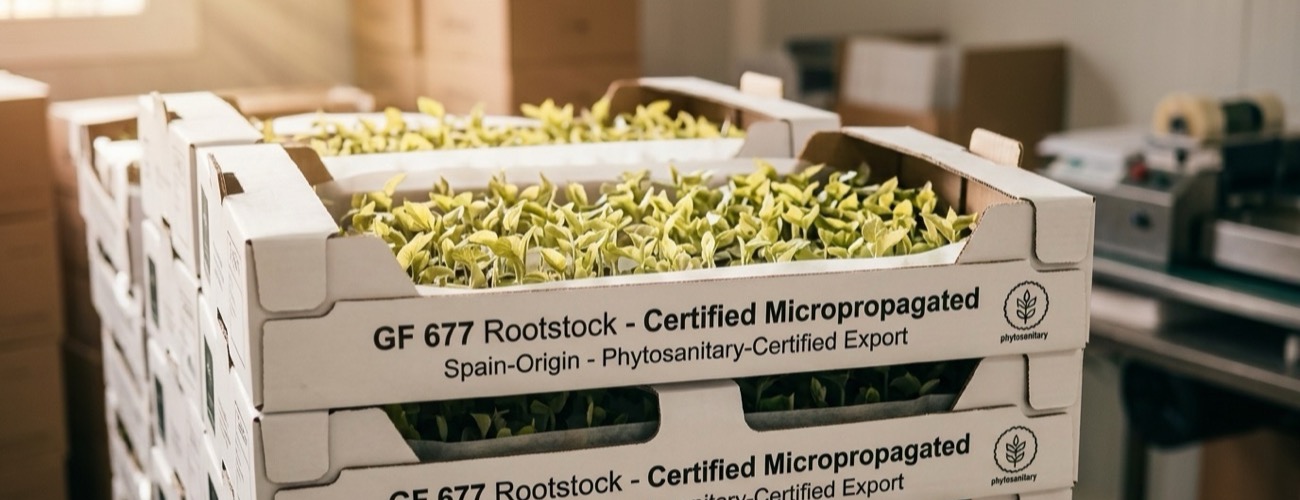
How Nurseries Import Certified GF 677 Rootstocks from Spain
How nurseries in Morocco, Turkey and the Middle East import certified GF 677 rootstocks from Spain: phytosanitary documents, transit and arrival handling.
Why nurseries outside the EU source GF 677 from Spain
A commercial nursery preparing for the next planting season faces a propagation problem that seedling production cannot solve. GF 677, the peach-almond hybrid bred by INRA in France, is the standard vigour rootstock for peach and almond across the Mediterranean, yet it cannot be multiplied economically from cuttings or seed. When a nursery's own mother stock can only supply a fraction of the plants its customers have ordered, the shortfall has to be imported, and it has to be imported as certified, genetically uniform material.
Spain is the natural sourcing hub for this trade. It shares a Mediterranean climate with Morocco, Turkey and the wider Middle East, so rootstocks raised there are adapted to the same calcareous soils, hot dry summers and irrigation regimes. Spanish micropropagation laboratories have produced hybrid rootstocks for fruit trees for decades, including GF 677 for peaches and almonds and Garnem® for peaches, almonds and nectarines, delivering healthy and uniform seedlings for nurseries, farmers and agricultural projects across the EU and North Africa.[1]
Why micropropagation solves the propagation bottleneck
Tissue-culture multiplication breaks the constraint that limits conventional nursery propagation. Tissue culture techniques allow a single screened mother plant to be multiplied into large, uniform batches of disease-free plants within a single production cycle, which is precisely what a nursery needs when it must build up volume in a new variety quickly. The laboratory's advanced techniques ensure consistent quality, disease-free plants and reliable large-scale supply.[1]
- Uniformity: every plant is a genetic copy of one verified genotype, so vigour, caliper and graft compatibility are predictable across the batch.
- Phytosanitary status: tissue culture excludes the viruses and systemic pathogens that cutting-grown stock can carry invisibly.
- Scalability: production is limited by laboratory capacity, not by the size of a mother block, so seasonal volume spikes can be planned.
The cost logic is unforgiving. Uncertified or virus-carrying stock raises early-stage mortality, produces uneven stands and can jeopardise an entire season's grafting programme. A nursery that plants cheap, unverified material replaces losses, re-grafts and loses customer confidence; a nursery that plants certified, virus-free rootstocks converts its purchase price into saleable trees on schedule.
What certified, virus-free GF 677 actually means
Certification is not a marketing label; it is a chain of documented checks that a buyer can and should verify. When a supplier claims virus-free GF 677, the claim rests on three things: the health status of the mother material, the multiplication method, and the regulatory authorisations held by the laboratory.
Virus-free status and genetic uniformity
Tissue-culture multiplication starts from mother material that has been screened and indexed for pathogens before entering culture. Because every plant is produced from that verified genotype under sterile conditions, micropropagated GF 677 is genetically uniform and free of the viruses that disrupt nutrient and water translocation in uncertified stock. The agronomic value of the clone itself is well documented: research on GF 677 describes a well-developed root system, vigorous growth and high grafting compatibility with peach, which is why it remains a reference rootstock in alkaline orchard soils.[2]
The Spanish regulatory markers to ask for
- SELECTOR certification: the first Spanish laboratory to receive official SELECTOR certification, published in the Boletín Oficial del Estado on 11 July 1990.
- Nursery registration number ES/09/08-0016: the registration under which certified, virus-free plants are produced under strict regulatory standards.
- A registered operator identity: an authorised producer receives its phytosanitary registration number from the National Plant Protection Organisation and can issue plant passports for eligible material.
A supplier that cannot state its registration number, or that cannot document the health status of its mother stock, is not offering certified material regardless of price.
Garnem: the sibling hybrid
Garnem® is the red-leaf peach-almond hybrid from Spain's CITA breeding programme, and it is the natural companion to GF 677 in the same order. It is a vigorous peach-almond hybrid rootstock for peach, almond and nectarine, and Spanish studies of almond × peach hybrids report its high vigour and adaptability to calcareous soils, with nematode resistance among the traits that made the Garnem family of rootstocks commercially significant.[3] For a nursery supplying both almond and stone-fruit orchards, ordering GF 677 and Garnem® from one certified source simplifies both the paperwork and the grafting schedule; a comparison of GF 677 and Garnem helps match the rootstock to the crop and soil priorities.
The export document set: phytosanitary certificates and plant passports
Every consignment of rootstocks leaving Spain for a third country travels with a defined document set. Understanding who issues each document, and what it legally attests, is the buyer's first line of defence against a consignment being held at the border.
The phytosanitary certificate
The phytosanitary certificate is the core export document. It is an official document issued by the National Plant Protection Organisation of the exporting country, certifying that the consignment has been properly inspected, is free from quarantine pests and meets the plant health import requirements of the destination country.[4] For a Spanish consignment, the certificate is issued through the official Spanish authority after inspection of the plants destined for export.
The EU plant passport
Within the EU plant health regime, a plant passport is mandatory for propagating materials, explicitly including rootstocks, and identifies the origin of the plants for traceability. Plant passports can only be issued by the National Plant Protection Organisation or by businesses officially registered and authorised by it; authorised operators receive a phytosanitary registration number. The passport's fixed elements, from the botanical name in element A to the country-of-origin code in element D, are listed below.
- Element A: the botanical name of the plant species (for GF 677, the peach-almond hybrid described above).
- Element B: producer Member State ISO code and the operator's phytosanitary registration number.
- Element C: the traceability code of the plant lot.
- Element D: ISO code of the country of origin or production.
The practical sequence
- Order confirmation: variety, rootstock, plant format, quantities and destination are fixed in the contract.
- Inspection: the consignment is inspected so the phytosanitary certificate can attest to its condition.
- Certificate issuance: the NPPO of the exporting country issues the phytosanitary certificate confirming the consignment meets the destination country's import requirements.[5]
- Pre-shipment copies: the buyer requests copies of the phytosanitary certificate, plant passport and packing documentation before the shipment departs, so any discrepancy is corrected while the plants are still in Spain.
The point of that last step is simple: a discrepancy caught while the plants are still in Spain costs a phone call, while the same discrepancy discovered at the destination border can hold the entire consignment.
Morocco: import controls under ONSSA
Morocco is the most relevant destination market for this trade, and its import regime is administered by the National Office of Food Safety (ONSSA). A nursery importing GF 677 from Spain deals with three layers of control: the legal framework, the seed and plant certification system, and border inspection.
Law No. 28-07 and border inspection
The import and export of plants and agricultural inputs are subject to regulations, in particular Law No. 28-07 on the health safety of food products, which lays down the sanitary conditions for admission to the national territory. Plants and agricultural inputs subject to sanitary and phytosanitary import controls must comply with the applicable regulations and must be accompanied by sanitary or phytosanitary documents duly signed by the official authorities of the country of origin. Compliance is monitored by quality control departments (Casablanca, Tangier and Agadir) and by border inspection posts (including Nador, Oujda and Rabat-Salé).[6]
The seed and plant control framework
The basis of the current Moroccan regulations dates back to 1969, when the dahir regulating the production and marketing of seeds and plants was promulgated, modified and completed in 1977. Its implementing texts cover the official catalogue, seed control and certification, plant control and certification, and the import and marketing of seeds and seedlings. Since the 2010 reorganisation of the ministry, these missions are carried out by ONSSA's Division of Seed and Plant Control, and the Moroccan seed and plant regulations are developed in accordance with international regulations, methods and standards, enabling Morocco to join or fulfil the conditions of equivalence to several international organisations, including ISTA, OECD, WTO, UPOV and the EU.[7]
Heightened biosecurity
Biosecurity scrutiny has intensified. ONSSA has issued a service memo suspending the importation of ornamental plants and plant parts from countries infested with Xylella fastidiosa, the quarantine bacterium that has reshaped EU plant trade controls.[8][9] For an importer, the lesson is that destination-market biosecurity rules can change quickly and apply to entire plant categories, not just to individual consignments.
Turkey and the wider Middle East: what changes
The document logic described for Morocco applies across the region: a phytosanitary certificate issued by the Spanish authority, import requirements set by the destination NPPO, and inspection at the border. What changes between markets is the agronomic demand driving the order.
Turkey: from seed rootstocks to clonal material
Turkish almond production has traditionally relied on seed rootstocks, and clonal rootstocks such as GF 677 and Garnem are the material through which irrigated, commercial almond orchards are now established. Recent Turkish research provides direct evidence for the shift: a two-year study of the almond cultivars Ferragnès and Ferraduel grafted onto Garnem, GF 677 and seedling rootstocks found that, although Garnem produced the highest yields, GF 677 combined high yield with favourable pomological characteristics, producing higher shelled and kernel weights and better fruit dimensions than Garnem, and was identified as the most suitable rootstock for both cultivars.[10]
Agronomic fit for calcareous and alkaline soils
Across Turkey and the Middle East, soil chemistry is the decisive factor. Research on GF 677 in alkaline orchard soils shows that peach varieties grafted onto it develop larger leaf area and significantly higher total nitrogen content than the same varieties on seedling peach rootstock, demonstrating higher nitrogen utilisation efficiency; the study notes that saline-alkali soils account for roughly 7 percent of the world's arable soils.[2] For nurseries serving irrigated orchards on calcareous ground, this is the agronomic argument that sells the clone to their own customers.
The third-country pattern
- Import permits: many NPPOs in the region require an import permit to be obtained by the importer before the consignment ships.
- Pest-risk requirements: destination authorities may impose additional declarations, testing or treatment on Prunus propagating material.
- Verification: requirements change, so buyers should confirm the current import conditions with their national plant protection authority before contracting, not after.
Transit and arrival handling: protecting plant viability
Most import losses do not happen in the laboratory or the paperwork; they happen in transit and in the first weeks after arrival. Young, recently deflasked plants are physiologically tender, and the receiving nursery's handling determines whether the batch realises its genetic potential.
How the plants travel
Micropropagated and semi-acclimatised rootstocks are packed for international transit to protect them from desiccation, temperature extremes and physical damage, and the consignment moves as documented propagating material accompanied by its phytosanitary certificate and plant passport. Ventilation, temperature stability and speed matter because young lab-raised plants have high mortality risk if they overheat, dry out or sit in transit longer than planned. The receiving nursery should agree the packing format and dispatch window with the supplier before the order is confirmed, and should have greenhouse space ready for the arrival date.
Arrival procedure at the border
- Document presentation: the phytosanitary certificate and accompanying documents are presented at the border inspection post, where compliance with the importing country's regulations is verified.[6]
- Physical inspection: the consignment may be inspected on arrival to confirm it matches the documents and is free from pests.
- If plants are held: a consignment that does not comply can be refused entry, returned, seized or destroyed.
Receiving-nursery protocol
- Immediate unpacking: plants are unpacked on arrival and inspected against the packing list and the certificate.
- Acclimatisation: the plants go into greenhouse conditions with controlled humidity and gradual exposure to ambient conditions, the critical phase for tissue-culture-derived material.
- Grading: once established, plants are graded by caliper and vigour before grafting or resale, so the batch delivers a uniform product to the next customer.
This protocol matches the core job of a commercial nursery in this trade: purchasing lab-grown plants and acclimating them in greenhouses for grafting and resale. A supplier that ships on a schedule the nursery can plan around is worth more than a marginal price difference.
Choosing a supplier and planning the order
The final decision is a verification exercise. The document set, the regulatory markers and the handling requirements described above give a nursery a concrete checklist to apply to any supplier offering certified GF 677 for export.
The supplier verification checklist
- Official nursery registration number: an authorised operator holds a phytosanitary registration number issued through the National Plant Protection Organisation.
- Virus-free certification of the mother stock: the supplier can document the health status of the material from which the batch was multiplied.
- Traceability: the plant passport identifies the origin of the plants, and its element C carries the traceability code of the plant lot.
- Willingness to issue phytosanitary certificates: the supplier exports routinely through the official Spanish authority and provides document copies before shipment.
What IN VITRO SL provides for this exact situation
IN VITRO SL's Fruit Tree Rootstocks (GF 677, Garnem®) offering is built for this buyer: certified virus-free fruit tree rootstocks micropropagated at large scale, including GF 677 for peaches and almonds and Garnem® for peaches, almonds and nectarines. The laboratory, founded in 1986, produces under the regulatory standing described above.[1]
Planning the order
Align the order with the planting season and with documentation lead times: the inspection and certificate issuance sequence takes time, and the plants should arrive when greenhouse space and grafting labour are ready, not before. Request a quote early and confirm the packing format and dispatch window in the contract, applying the pre-shipment document checks described above. For certified GF 677 and Garnem® rootstocks micropropagated for nursery and plantation projects, the starting point is the micropropagation of fruit trees page, where current availability and quotes are handled directly.
Frequently asked questions
Can I import GF 677 rootstocks into Morocco without a phytosanitary certificate?
No. Under Morocco's Law No. 28-07, plants entering the national territory must comply with applicable regulations and be accompanied by phytosanitary documents duly signed by the official authorities of the country of origin. Consignments are checked at border inspection posts, and non-compliant plants are returned, seized or destroyed.
What is the difference between a plant passport and a phytosanitary certificate?
A plant passport accompanies plants traded between businesses inside the EU and can only be issued by operators registered and authorised by the National Plant Protection Organisation. A phytosanitary certificate for export is issued by the NPPO of the exporting country and certifies that the consignment meets the import requirements of the destination country outside the EU, such as Morocco or Turkey.
Why is GF 677 well suited to Moroccan and Middle Eastern soils?
GF 677 is a peach-almond hybrid with strong resistance to iron-deficiency chlorosis and a well-developed root system. Research shows peach varieties grafted onto GF 677 develop larger leaf area and higher nitrogen utilisation efficiency in alkaline orchard soils, and the rootstock is suited to soils with low water availability and high calcium carbonate content.
Is Garnem an alternative to GF 677 for my nursery?
Yes. Garnem is a red-leaf peach-almond hybrid from Spain's CITA programme with high vigour, nematode resistance and adaptability to calcareous soils. In a two-year Turkish almond trial, Garnem produced the highest yields while GF 677 delivered higher kernel weights and was identified as the most suitable rootstock overall, so the choice depends on the crop and soil priorities of the receiving nursery.
What documents should I receive before a GF 677 consignment leaves Spain?
At minimum, a copy of the phytosanitary certificate for export issued by the Spanish authority and the traceability information linked to the producer's registration. Buyers should also verify the supplier's official nursery registration number and the virus-free certification of the mother stock before contracting.
What happens if documents are missing or incorrect at the border?
The consignment can be delayed, returned, or seized and destroyed under the importing country's legislation. In Morocco, ONSSA applies these measures to plants that do not meet import conditions, which is why document verification before dispatch is a standard part of professional plant sourcing.
How should my nursery handle GF 677 plants on arrival?
Unpack and inspect the consignment immediately after border clearance, then move semi-acclimatised plants into greenhouse conditions for acclimatisation before grading, grafting or resale. Early-stage micropropagated plants are the most vulnerable phase, so ventilation, temperature stability and prompt handling directly affect survival rates.